Update…
Finally updated, my real homepage, where I keep what is more or less an archive of my published writing. For those who like old-skool html: http://ariealt.home.xs4all.nl/. Of course it’s 100% iPhone 5 optimized…
Finally updated, my real homepage, where I keep what is more or less an archive of my published writing. For those who like old-skool html: http://ariealt.home.xs4all.nl/. Of course it’s 100% iPhone 5 optimized…
Vorige week las ik Adolfo Bioy Casares’ Ontsnapping van Duivelseiland, vertaling uit 1974 – nooit heruitgegeven. Vroeger zou ik zo’n boek van de bibliotheek hebben geleend, maar dit soort vertalingen is toch in rap tempo uit de openbare bilbiotheken verdwenen. Nee, ze staan ook niet meer in het magazijn. Ik koop ze nu. Vreemd verhaal – niet zo geslaagd als Morel’s uitvinding, misschien omdat Casares zich hier ook op stijlniveau laat leiden door een fantastische logica.
Daarna (eindelijk?) de verhalenbundel The Angel Esmeralda van Don Delillo. Impeccable style. Ben geneigd mijn mening over Delillo’s oeuvre nog eens te herhalen omdat de vroegste verhalen uit deze bundel me het beste bevallen. Misschien dat de laatste verhalen ‘beter’ zijn – vanuit een soort klassiek perspectief, maar ik vond ze iets te gemaakt (qua setting), en soms een herhaling van zetten.
Anyway, bepaald geen niet-te-missen Delillo – de niet-te-missen Delillo’s, dat zijn de vroege romans – wel woord-voor-woord de moeite waard.
(De vroege romans – Van Americana tot en met The Names zijn visionair, vreemd, daar is het alsof Delillo zelf ook niet helemaal begrijpt wat hij registreert en verbeeld. Ze hebben een ‘flaw’, juist daardoor blijven ze fascineren. Daarna volgen de klassiekers waarin hij de Amerikaanse conditie ‘treft’: White Noise en Libra, en Mao II. Underworld is ‘ten slotte’ het boek waarin alles samenkomt, en wordt uitgelegd. Alles wat daarna komt is behoorlijk goed (naar literaire standaarden), maar heeft mij nooit zo kunnen treffen als de vroegere romans – met uitzondering van Point Omega).
Weekje vakantie. Geen laptop mee. Internet gemist? Geen moment. (En mobiele telefoon uit).
Gelezen. Wildernis – de verrassend goed lopende vertaling (door Joyce & Co) van Kerouac’s Big Sur; Het sublieme van Hartog Hans den Jager; Visit Sunny Chernobyl (nou, half…) van Andrew Blackwell; wat uit Huhtahmo & Parikka’s Media Archaeology; 4 hoofdstukken Ulixes in de vertaling van Henkes & Bindervoet; Boris Vian’s Herfst in Peking (vond ik voor 1 euro); Suspensions of Perception van Jonathan Crary ‘doorgewerkt’ (d.w.z. op zoek naar…, niet heel aandachtig); de helft van An Outcast of the Islands van Joseph Conrad; en Ton Lemaire’s Wandelenderwijs.
“Calling Facebook a big social experiment implies that the network opens up new possibilities for the service’s users to change society, when in fact those opportunities rest with the site’s administrators and the minions who can access the whose of the data trove. Rather than crack society open and make it open to experiment, it helps preserve existing social relations and make them more supple and instrumental for those who already are in power. This really shouldn’t be news to anyone: Facebook is not an experiment; it’s a jail.”
From: http://thenewinquiry.com/blogs/marginal-utility/facebook-as-experiment/
Leesvoer voor de zomer? JR? Opschieten, voor volgende week de eerste 150 pagina’s lezen om mee te doen met OccupyGaddis. Ik niet, ik zit net enorm te genieten van Ulixes de nieuwe Nederlandse vertaling van Ulysses door Henkes & Bindervoet.
“When, as a critic, I call something literature, I mean that it expands the field of what literature can be. David Foster Wallace is literature. Jonathan Franzen just tried to write a literary novel.” Stuart Kelly in his review of Eagleton’s The Event of Literature, www.guardian.co.uk/books/enz.
Next week there’s a so-called book-sprint at V2_, and a team with a.o. Michael Dieter, Nat Muller and David Berry will have a week to write a book on, I think, politics and the new aesthetics.
I might in turn report on it, and in preparation I get entangled in the recent discussion on the a-politicalness of OOO. See for instance these posts:
Alex Galloway on Graham Harman: itself.wordpress.com/2012/06/03/a-response-to-graham-harmans-marginalia-on-radical-thinking/,
David M. Berry on OOO and politics:
stunlaw.blogspot.no/#!/2012/06/new-bifurcation-object-oriented.html, and
stunlaw.blogspot.no/#!/2012/05/uses-of-object-oriented-ontology.html
Interesting, but I’m not sure I agree with either of them. Harman is clearly not a political philosopher – did anybody assume he was? OOO is very much hardcore ontology (in the hands of Meillasoux or Harman), and sometimes pretty hard to grasp in its theoretical rigour (for a non-professional who hasn’t got a proper understanding of, for instance, Husserl) – and that is where it becomes interesting. It’s made easy-going and simple sometimes, especially on all the blogs, but that is where I get uncomfortable…
Something like that… I’d need a day to properly explain. And well, I do not have that day.
Ah, a good response to Galloway is in the comments: http://itself.wordpress.com/2012/06/03/a-response-to-graham-harmans-marginalia-on-radical-thinking/#comment-27766.
Etc.
Weinig geconcentreerde leestijd. Veel half gelezen, veel voor een kwart, soms een heel boek. Onder andere Silas Marner van George Eliot, Wessex Tales van Thomas Hardy (en stukjes uit verschillende van zijn romans), Robert Kaplan’s geschiedenis van nul, The Nothing that is, en Nothing, A very Short Introduction van Frank Close, het grootste deel van Geert Lovink’s boek over social media, Collapse VII, de nY (en nog wat tijdschriften zoals de DeBug), wat Daniel Defoe, stukjes Philip K. Dick – en de rest herinner ik me nu niet. Oh, ja, wat uit Isabelle Stengers (Cosmopolitics II), en natuurlijk het gewoonlijke gegrasduin…
Ik meld het maar, om het mezelf in de toekomst te herinneren.
But I don’t feel like keeping accounts.
… ik zie dat OMC ‘t citeert – & ik vind ‘t een klassieker:
“Jarry was no Bois de Boulogne buff. He belonged to the avant-garde community of writers and artists. For these people cycling was more than just a pleasure, and a cycle ride could be just as beautiful or radical as a poem or a painting. They were often passionate cyclists, undaunted by Paris traffic, and many of them enjoyed the sweaty pleasures of strenuous long distance riding. They saw the bicycle as a liberator, a machine to extend the potentialities of the human being. Jarry described it as an ‘external skeleton’ which allows mankind to outstrip the process of biological evolution.”
Eindelijk gelezen: Timothy Morton’s tweede boek The Ecological Thought, (en daarvoor het begin van Ecology Without Nature). Dark ecology, niet het groene-let’s-preserve-the-environment-denken, maar een radicaler uitgaan van de verbondenheid van alles met alles. Ik weet niet zeker of ik het in alle opzichten eens ben met Morton, maar zijn filosofisch voorstel brengt ons veel verder dan de traditionele ‘groene’ politiek (in het voorstellen van de wereld, en een toekomst).
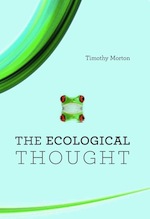
Tim Morton – as you might know – blogt en zet lezingen en lessen online: ecologywithoutnature.blogspot.com/