Vriezen, Mettes, Parmentier

Today:

Samuel Vriezen on curiosity, ‘Ernstige Muziek’, ‘Muziek van verpozingsaard’ and the BUMA/STEMRA: http://blogger.xs4all.nl/sqv/.

Jeroen Mettes has some good thoughts on electronic poetry: http://n30.nl/2006/05/vertraagde-speculaties-over-zgn.html.

And the newest issue of Parmentier (http://www.literairtijdschriftparmentier.nl/) deals with electronic literature and comes just too late for me. (De Tribune didn’t have it yesterday, and my text is due friday).

en,reading matter,writing | May 24, 2006 | 12:22 | Comments Off on Vriezen, Mettes, Parmentier |

48 / 2.00

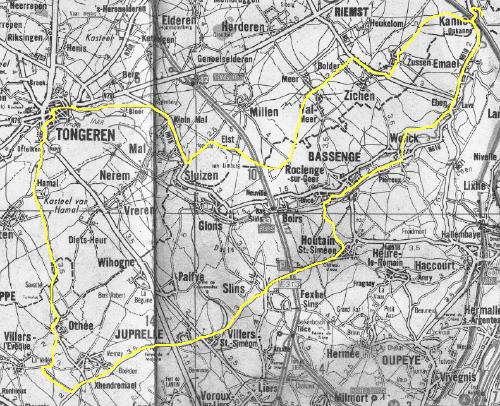
19.50 – 21.50. Na een regenbui: veel zon. Wel vrij koud. Zoveel mogelijk vlak, richting Wandre. Weer zo’n Houtepen-klim: de Rue Tesny. Steil omhoog, smal, slecht asfalt en een stuk langer dan je zou verwachten, achteromkijkend een adembenemend uitzicht, en verder is het, euhm, zo’n klim die goed te doen is met 30 x 24. Lekker. (Tenminste, vandaag).

Kanne – kanaal – Haccourt / Vise – langs de Maas – Hermalle – (verder langs de Maas, loopt dood en terug naar de brug) – Sarolay – Cheratte – Veille Voie – Wandre – Rue Tesny – Cheratte – Sarolay – Richelle – Dalhem – Vise – kanaal – Kanne

cycling,nl | May 24, 2006 | 12:15 | Comments Off on 48 / 2.00 |

A poem is

simply ‘the actuality of the words’.

en,writing | May 23, 2006 | 16:56 | Comments Off on A poem is |

Van Bastelaere

So went out and bought Van Bastelaere’s ‘De voorbode van iets groots’ at De Tribune, Maastrichts nicest bookstore. Read through it once now. I do not read poetry slowly, at least not when reading through it the first time. And wrt Van Bastelaere I have the impression that some poems work best when read rather quickly. Especially the poems in which he uses a lot of ‘fragments’ — just bits of language, quotations, cliche’s — will not work when read slowly. (I think now).

Marjorie Perloff wrote in the preface to Radical Artifice: Writing Poetry in the Age of Media, “There is today no landscape uncontaminated by sound bytes or computer blips, no mountain peak or lonely valley beyond the reach of the cellular phone and the microcassette player. Increasingly, then, the poet’s arena is the electronic world.” She wrote that in 1991.

The world of Van Bastelaere is made just as much of the mythology of action movies (a very one dimensional mythology, that he sort of deconstructs to show what desires are at play there — but because the mythology is one-dimensional, the deconstruction also comes out one-dimensional) and the postmodern desire and fear of catastrophe (the theme that keeps this book together). And there’s a messianic bit as well (in Whoooosssssh). The references are all well-known. And actually he often plays, I think, with quoting in very beautiful Dutch, sentences which one knows from for instance Burroughs (‘who scared you into this flesh?’), Gibson, Delillo or Ballard. At least, so is my impression. Or, for that matter, from action movies, or Blanchot.

Which make these poems a bit 1990’s as well. (They might be from the ’90s, partly, at least Zapruder Stress was already published (in a different form) years and years ago).

Van Bastelaere has a particular good ear for language, and plays often with making you expect one thing, then turning the sentence into another direction. Easy example: “Dit is waar / Het verhaal eindigt”; which makes you read: “This is true / The story ends”, immediately correcting yourself into reading “This is where / The story ends”). Van Bastelaere uses such poetic ‘tricks’ a lot, to good effect. Another is the use of loose bits of spoken language, just utterances, sometimes he just strings them together. They form a sort of language canvas… . It’s as with the ‘almost quotations’, that you think you remember recognize, but not quite, and before you can wonder about it, the poem is elsewhere already. This is the language of which our world is made (if you listen closely… a girl walks by the window and I hear her say ‘Ooh, dat is zo….’ )

It reminds me of Creeley’s use of rhythm. But a radicalized version of it.

I like those effects. I do not find them disturbing, I do not get the feeling that Van Bastelaere is playing a game against me, or tries to undermine my preconceptions of what poetry is or should be.

But then, I am a reader who is not bothered by not getting to the core of a ‘meaning’. I read poetry for rhythm and sound as much as for meaning. Or for the voyage through language.

My 2 cents. (For now).

en,reading matter,writing | May 23, 2006 | 16:55 | Comments Off on Van Bastelaere |

Procrastination or, euh, research, is it?

Have to start writing down the actual sentences for my text about the electronic/multimedia/internet/new media-poetry shown at De Waag last week. But I click’n read from poetry-blog to poetry-blog. Making the rounds: the weekly ones (a.o. Mettes: http://n30.nl/poezienotities.html, Contrabas: http://www.decontrabas.com/, Silliman), the monthly ones (Inwijkeling: http://reugebrink.skynetblogs.be/), and checking out what has happened in the e-poetry scene in the past months.

I read the discussions about Dirk van Bastelaere’s new book. Van Bastelaere was (is?) definitely one of my favorite poets. There are not many poems that I have read as often as those in Pornschlegel and Diep in Amerika. Yet I was disappointed by Hartswedervaren and Van Bastelaere’s current theoretical interests (Lacan…) are certainly not mine. And yet, even the poems in Hartswedervaren, I think, are stronger than those of Stefan Hertmans (who’s much milder, & whom I also continue to follow), or the much-praised Peter Verhelst, whose work to me always has seemed to be artificial and ‘unreal’ (‘gewild’ — tho that’s a very problematic criticism… I know). Hmm. anyway, I have to get a copy of Van Bastelaere’s de voorbode van iets groots today — so I can give my 2 cents…

I read Silliman on the poetics of Charles Olson — a very nice piece: http://ronsilliman.blogspot.com/2006/05/breathe-say-all-manner-of-meditators.html. Olson’s ideas about breath and projective verse are another ‘topic’ that I keep going back to (or ending up with?)

But what is this… research? Or am I postponing the moment to ‘jot down’ the first real draft of my text.

en,reading matter,research,writing | May 23, 2006 | 13:34 | Comments Off on Procrastination or, euh, research, is it? |

JJ Johnson

I have a soft spot for the trombone-playing of JJ Johnson. That might sound strange, since Jay Jay is definitely more “good taste”, and less wild, exciting and pushing boundaries than my favorites for the period say 1954 – 1959: Coltrane, Clifford Brown, Rollins. (Not to mention freejazz and all the other sorts of music that some people dissmiss as difficult…). Last week I was very happy to find the Complete Columbia Small Group Sessions of JJ Johnson. These are basically his recordings with either a quintet with Bobby Jaspar and Elvin Jones, and a quartet with Flanagan, Chambers and Roach. I knew some tracks and had searched in vain for it before (the library didn’t have these). It’s a joy to hear such precise playing and arrangements that are equally precise, without becoming precious (precieux). They are the definition of ‘classic’. It asks for precise listening as well — or actually, you will realize at some point that you are listening carefully (instead of just nodding your head to the rhythm). This is the kind of playing that makes me envious. I wish I could play like this — then I’d be able to play everything…

en,music | May 23, 2006 | 13:10 | Comments Off on JJ Johnson |

52 / 2.30

Waarschijnlijk mn laagste gemiddelde ooit. 16.30 – 19.00. Eerst pal tegen de harde zuidenwind in, dan tussen Wandre en Cheratte een felle bui, gevolgd door een schoongeveegde heldere hemel en fijne zon. Ik peddelde daarna genietend door Cheratte, zocht een klim die er niet was (de Rue Tesny, die ligt namelijk in Wandre, niet in Cheratte). Vervolgens wandelfietstend — ik was ook moe na het Ubiscribe-weekend — met de wind in de rug terug naar Kanne. Een rondje met Houtepen-klimmetjes: de Lorette en de Rue de Hennen in Vise, de Rue du General Thys in Dalhem, en de Veille Voie in Cheratte. Gek genoeg heb ik meer moeite met de Limburgse kuitenbijters dan met zo’n vreselijk steile Veille Voie.

Kanne – kanaal – Haccourt – Vise – Lorette – Dalhem – Rue General Thys – Trembleur – St. Remy – Housse – Wandre – Cheratte – Veille Voie – Sarolay – Vise – Rue Hennen – kanaal – Kanne

cycling,nl | May 23, 2006 | 13:08 | Comments Off on 52 / 2.30 |

Raymond Federman blogs

I should’ve known. Of course Raymond Federman blogs: http://raymondfederman.blogspot.com/. Federman is another PM-AmLit-writer, but he’s bilingual (French – American). His work is wildly innovative, full of life and funny, and very moving.

Years ago I translated his most dense work The Voice in the Closet / La voix dans le cabinet de debarras; my translation was published by Perdu (http://www.perdu.nl) and is since long sold out. The text is available online at different locations (probably even at my own site… one forgets what one has put online…. ah yes, there it is: http://www.xs4all.nl/~ariealt/stem.html and http://www.xs4all.nl/~ariealt/voice.html, and also here: http://www.federman.com/voice.htm).

It was in fact one of the first things I did, after finishing my studies (with a thesis on Federman and theories of postmodern fiction) — without any real experience in translating. (Well, one has to start somewhere).

en,free publicity,reading matter,writing | May 21, 2006 | 12:32 | Comments Off on Raymond Federman blogs |

Gilbert Sorrentino

From Ron Sillimans’ blog (http://ronsilliman.blogspot.com/) I learn that Gilbert Sorrentino has died a few days ago. I was just reading his Splendid Hotel, a book of short prose sketches, almost poems, about the 26 letters of the alphabet. Very beautifully written, very precise. Sorrentino is best known for his “postmodern masterpieces” Mulligans Stew and Aberration of Starlight. There’s still so much good stuff to read…

http://www.centerforbookculture.org/dalkey/bio_gsorrentino.html
http://www.centerforbookculture.org/interviews/interview_sorrentino.html

en,free publicity,reading matter | May 21, 2006 | 12:07 | Comments Off on Gilbert Sorrentino |

De Certeau on Reading

Reading through De Certeau’s book, checking if there’s anything that I should read or reread (I read a few chapters in the past). Struck by the fact that De Certeau is all the time assuming the existence of power-structure/master-discourse, against which the people/users devise their own counter-strategies. In that way a common poetics will always be defined as something which insinuates itself inside, is set up against, that which is in ‘power’. (Does this make sense — or have I been reading too quickly?)

‘Reading is thus situated at the point where social stratification (class relationships) and poetic operations (the practitioner’s constructions of a text) intersect: a social hierarchization seeks to make the reader conform to the “information” distributed by an elite (or semi-elite); reading operations manipulate the reader by insinuating their inventiveness into the cracks in a cultural orthodoxy.’ Michel de Certeau, ‘Reading as Poaching’, inThe Practice of Everyday Life, University of California Press, Berkeley etc., 1984, p. 172

en,quotations,reading matter,research | May 19, 2006 | 14:37 | Comments Off on De Certeau on Reading |
« Previous PageNext Page »
This work is licensed under a Creative Commons Attribution-NonCommercial-ShareAlike 2.5 License. | Arie Altena