Z’n langverwachte boek over het ‘moving panorama’. Ik interviewde Huhtamo vorige maand (die tekst komt binnenkort op de Sonic Acts website). Las ook zn boek – wel, zoals dat gaat bij allerlei andere beslommeringen en verplichtingen: doorgewerkt, geracet, maar nog niet werkelijk, echt, hoofdstuk na hoofdstuk, zin voor zin, gelezen, en dus niet in staat om een echte recensie te schrijven. Wel genoeg om te zeggen: een boek om enthousiast van te worden.
Recensie van Jan Baetens & Arnoud van Adrichem: http://www.dereactor.org/home/detail/schateiland_van_het_bewegend_panorama/
http://www.faz.net/frankfurter-allgemeine-zeitung/enzensbergers-regeln-fuer-die-digitale-welt-wehrt-euch-12826195.html
Of, een simpele herinnering voor een algemeen lezerspubliek: hoezeer we veranderd zijn. (De regels zelf zijn al niet meer na te leven – niet alle 10 – zonder vrij radicaal afscheid te nemen van de huidige maatschappij). Neemt niet weg: het zijn 10 regels voor een beter leven.
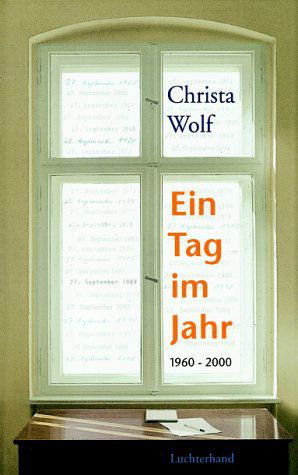
Als verslag. Want anders ben ik het zelf binnen een week vergeten. Ik las zo’n 150 pagina’s uit Christa Wolf’s Ein Tag im Jahr, 1960 – 2000. Ieder jaar de 27e september nauwgezet beschreven. Boeide me aanvankelijk – vooral het dagelijks leven, opvoeden van de twee kinderen, de strijd om concentratie en tijd te vinden voor het schrijven. Christa Wolf’s werk heb ik verder nooit gelezen. Het boeide me niet. De DDR boeide me niet, de moeizame verhouding tot het ‘systeem’ boeide me niet, de vorm van engagement boeide me niet. Dat interesseert me nu meer. Maar na 150 pagina’s begon ik het op te geven. Las nog wat vooruit, las wat van de laatste jaren. Het boeide me niet meer. Wat een moeizaamheid, die problematiek, verstrikt in een systeem en toch willen blijven geloven in een maatschappijvorm die je (zo lijkt het toch) zelf geen goed doet. Moeilijke positie, zeker onterecht om het zo af te serveren, waarschijnlijk de moeite waard om echt door te denken en je in te verdiepen. Maar nee, dat is niet voor mij, dat is voor iemand anders. (En ergens ook een gevoel dat er fundamenteel iets mis is in dit boek – een onoprechtheid, een angstig verzwijgen – bij alle pogingen om eerlijk en oprecht te zijn).

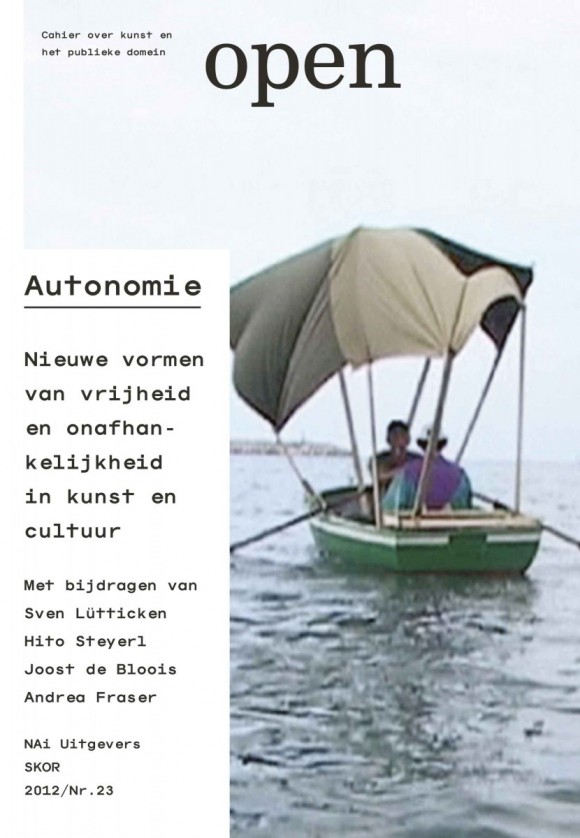
Ook doorgelezen, de Open over autonomie. (‘In een tijd van ideologische en politieke crises, waarin mensen en dingen meer op zichzelf worden teruggeworpen, gaat van autonomie een hernieuwde aantrekkingskracht uit.’) Vooral om te zien of ik iets had gemist… Of niet. Niet echt. (Neemt niet weg dat het een mooi nummer is – en zo’n beetje alles wordt gecoverd).
Volgende week hoop ik daar te zijn (weersvoorspelling: 9 graden). Gisteren was het er 29 graden. Ver boven de poolcirkel.
http://barentsobserver.com/en/nature/2013/05/very-warm-welcome-barents-summit-31-05

Hertmans: ‘Nee. Ik denk eerder dat een grammatica de verhoudingen in de samenleving weerspiegelt. Constructies met lijdende en meewerkende voorwerpen drukken verhoudingen uit. Jongeren van nu worstelen met ingewikkelde zinsbouw. Terwijl complexiteit in de syntaxis begrijpen, ook helpt om andermans argumentatie te vatten. Ze legt de basis van je democratische weerbaarheid, zorgt ervoor dat je kunt antwoorden.’
(Via: http://www.knack.be/nieuws/boeken/reportage/proust-joyce-en-mann-dreigen-onleesbaar-te-worden-stefan-hertmans/article-4000282450347.htm)
Here’s the call for the Sonic Acts Masterclasses – an excellent opportunity to ‘be educated’ by Goodiepal, CM von Hausswolff/Mike Harding, the Vasulkas, Tony Conrad and/or Trevor Paglen. Some are just one day, others stretch over several days. Info on: http://2013.sonicacts.com/programme/masterclasses/. Apply before the 5th of February!
“Calling Facebook a big social experiment implies that the network opens up new possibilities for the service’s users to change society, when in fact those opportunities rest with the site’s administrators and the minions who can access the whose of the data trove. Rather than crack society open and make it open to experiment, it helps preserve existing social relations and make them more supple and instrumental for those who already are in power. This really shouldn’t be news to anyone: Facebook is not an experiment; it’s a jail.”
From: http://thenewinquiry.com/blogs/marginal-utility/facebook-as-experiment/
Word frequency in Pynchon – built with Processing: tinysubversions.com/pynchon/index.html
The most frequent words in GR are a poem:
Time
know
way
old, white, right
little long
night
light
face, day
inside, oh
black eyes
look, really man
good.
(Or maybe it should stop earlier, or later – ).
Next week there’s a so-called book-sprint at V2_, and a team with a.o. Michael Dieter, Nat Muller and David Berry will have a week to write a book on, I think, politics and the new aesthetics.
I might in turn report on it, and in preparation I get entangled in the recent discussion on the a-politicalness of OOO. See for instance these posts:
Alex Galloway on Graham Harman: itself.wordpress.com/2012/06/03/a-response-to-graham-harmans-marginalia-on-radical-thinking/,
David M. Berry on OOO and politics:
stunlaw.blogspot.no/#!/2012/06/new-bifurcation-object-oriented.html, and
stunlaw.blogspot.no/#!/2012/05/uses-of-object-oriented-ontology.html
Interesting, but I’m not sure I agree with either of them. Harman is clearly not a political philosopher – did anybody assume he was? OOO is very much hardcore ontology (in the hands of Meillasoux or Harman), and sometimes pretty hard to grasp in its theoretical rigour (for a non-professional who hasn’t got a proper understanding of, for instance, Husserl) – and that is where it becomes interesting. It’s made easy-going and simple sometimes, especially on all the blogs, but that is where I get uncomfortable…
Something like that… I’d need a day to properly explain. And well, I do not have that day.
Ah, a good response to Galloway is in the comments: http://itself.wordpress.com/2012/06/03/a-response-to-graham-harmans-marginalia-on-radical-thinking/#comment-27766.
Etc.