Typography

More reading matter (on the train): the most recent issue of the Flemish arts magazine De Witte Raaf. This issue focusses on typography. De Witte Raaf has quite a close connection to the Jan van Eyck, with director Koen Brams as on of the editors & frequent contributors to the magazine. Some (not all) of the JVE-approach to artistic research is reflected in the theoretical approach & editorial focus of De Witte Raaf. This issue also has a long interview with Jan van Eyck’s advising researcher Filip Tacq. But my ‘favorite’ in this issue is Dirk van Hulle’s article on typography and full stops in Joyce’s Ulysses and FW.

De Witte Raaf online here: http://www.dewitteraaf.be/web/flash/default.asp.

Dirk van Hulle’s article: http://dewitteraaf.stylelabs.com/web/flash/content.asp?enz..

Which reminds me that if you would ask me which is the single most influential bookpage for my ‘taste’ of literature & design, it would be page 260 of FW. Or no, it would be the page in the Spectrum Encyclopedie, with the lemma on Joyce, that reprinted page 260 of FW.

(Btw, this is a Dutch encyclopedia from the nineteen-seventies that was organized in longer lemmata — in length between half a page, up to over 20 pages — with lots of cross-referencing: both links at the end of a lemma, indicating related articles, and ‘underlined links’ in the running text. My parents bought this encyclopedia when it was being published, which meant we would get a new ‘tome’ when it would come out. I have spent many many hours reading and browsing this encyclopedia. And I sometimes wonder if my ‘early’ interest in hypertext has been influenced by it.

The wikipedia entry is a bit on the short side: http://nl.wikipedia.org/wiki/Grote_Spectrum_Encyclopedie. Here’s what ‘bison’ says: http://cf.hum.uva.nl/nhl/bizon/grote_spectrum.htm.)

Which also reminds me that I haven’t yet referenced Jouke Kleerebezem’s most recent article “Onderzoek worden” (“Becoming Reseach”) — in Dutch –: http://dewitteraaf.stylelabs.com/web/flash/showfile.asp?enz..

en,free publicity,reading matter,research,ubiscribe | September 29, 2006 | 14:51 | Comments Off on Typography |

Reading through The Public and its Problems II

“The transition from family and dynastic governement supported by the loyalties of tradition to popular was the outcome primarily of technological discoveries and inventions working a change in the customs by which men had been bound together.” p. 144

“Regarded as an idea, democracy is not an alternative to other principles of associated life. It is the idea of community life itself.” p. 148

“It is an ideal in the only intellegible sense of an ideal: namely the tendency and movement of some thing which exists carried to its final limit, viewed as completed, perfected. Since things do not attain such fulfillment but are in actuality distracted and interfered with, democracy in this sense is not a fact and never will be. But neither in this sense is there or has there ever been anything which is a community in its full measure, a community unalloyed by alien elements.” p. 148

“Associated or joint activity is a condition of the creation of a community. But association itself is physical and organic, while communal life is moral, that is emotionally, intellectually, consciously sustained.” p. 151

“Associated activity needs no explanation; things are made that way. But no amount of aggregated collective action of itself constitutes a community.” p. 151

“Interactions, transactions, occur de facto and the results of interdepence follow. But participation in activities and sharing in results are additive concerns. They demand communication as a prerequisite.” p. 152

[How to arrive at a Great Community?]
“… the perfecting of the means and ways of communication of meanings so that genuinely shared interest in the consequences of interdependent activities may inform desire and effort and thereby direct action.” p. 155

“[K]nowledge is a function of association and communication; it depends upon tradition, upon tools and methods socially transmitted, developed and sanctioned.” p. 158

“There can be no public without full publicity in respect to all consequences which concern it. Whatever obstructs and restricts publicity, limits and distorts public opinion and checks and distorts thinking on social affairs.” p. 167

“Science is converted into knowledge in its honorable and emphatic sense only in application. Otherwise it is truncated, blind, distorted.” p. 174

“Record and communication are indispensable to knowledge. Knowledge cooped up in private consciousness is a myth, and knowledge of social phenomena is peculiarly dependent upon dissemination, for only by distribution can such knowledge be either obtained or tested. A fact of community life which is not spread abroad so as to be a common possession is a contradiction in terms.” p. 176-177

“Public opinion , even if it happens to be correct, is intermittent when it is not the product of methods of investigation and reporting constantly at work. It appears only in crises. Hence its “rightness” concerns only an immediate emergency.” p. 178

“But its meaning [of the news] depends upon relation to what it imports, to what its social consequences are”. p.180

“The function of art has always been to break through the crust of conventionalized and routine consciousness. Common things, a flower, a gleam of moonlight, the song of a bird, not things rare and remote, are means with which the deeper levels of life are touched so that they spring up as desire and thought. This process is art.” p. 184

“We have but toouched lightly and in passing upon the conditions which must be fulfilled if the Great Society is to become a Great Community; a society in which the ever-expanding and intricately ramifying consequences of associated activities shall be known in the full sense of that word, so that an organized, articulate Public comes into being.” p. 184

“The highest and most diffficult kind of inquiry and a subtle, delicate, vivid and responsive art of communication must take possession of the physical machinery of transmission and circulation and breathe life into it. When the machine age has thus perfected its machinery it will be a means life and not its despotic master.” p. 184

“Democracy will come into its own, for democracy is a name for a life of free and enriching communion.” p. 184

“But while associated behavior is, as we have already noted, a universal law, the fact of association does not of itself make a society. This demands (…) perception of the consequences of a joint activity and of the distinctive share of each element in producing it.” p. 188

“Individuals find themselves cramped and depressed by absorption of their potentialities in some mode of association which has been institutionalized and become dominant. They may think they are clamoring for a purely personal liberty, but what they are doing is to bring into being a greater liberty to share in other associations, so that more of their individual potentialities will be released and their personal experience enriched.” p. 193-194

“Vision is a spectator; hearing is a participator. Publication is partial and the public which results is partially informed and formed until the meanings it purveys pass from mouth to mouth.” p. 219

en,quotations,research,ubiscribe | September 26, 2006 | 17:37 | Comments Off on Reading through The Public and its Problems II |

Upgrade, the graduates…

Tomorrow — wednesday 27th — I’ll be on a panel at Upgrade Amsterdam, the Graduates, discussing the work of recently graduated young artists. De Melkweg, entrance = free, 20.30h.

“Each summer many promising young artists and designers bid their art academies farewell, and graduate. The third Upgrade! Amsterdam, scheduled September 27th, offers a stage to these new young “hotties” to pitch their work to a larger audience, under the scrutinising gaze of a panel of experts and art academy tutors. Most of the installations will be on display during the program.”

See: http://www.melkweg.nl/artikelpagina.jsp?enzvoorts.

en,free publicity | September 26, 2006 | 16:57 | Comments Off on Upgrade, the graduates… |

Mark Z. Danielewski

The new Ballard is out. The new Powers coming up. The new Pynchon announced for 21st November. I missed that Mark Z. Danielewski had a new book published: Only Revolutions, A Novel. Described as “A pastiche of Joyce and Beckett, with heapings of Derrida’s Glas and Thomas Pynchon’s The Crying of Lot 49 thrown in for good measure”. Hmmm, with such a description I expect the book to be either very very good, or shallow and forgettable but funny.

en,free publicity,reading matter | September 25, 2006 | 12:55 | Comments Off on Mark Z. Danielewski |

Free, free culture & information (or almost free, that is)

The radio woke me up — as it does almost every morning. And I woke up to an interview of professor Ronald Soetaert about ‘literacy and the culture of reading’, on account of the publication of De cultuur van het lezen, a report and essay published by the Taalunie (language institute). Free for download here: http://taalunieversum.org/taalunie/publicaties/. I wonder if it’ll go beyond ‘leesbevordering’ (sorry, no idea how to say that in English…).

The wonderful http://destination-out.com/ posts three pieces of saxophonist and composer Sam Rivers, and writes: “but it’s somewhat amazing to us that Rivers is not better known, if not more celebrated.”

Tonight at OT301, 21.30 another DNK-concert, with Justin Bennet solo, and Juan de la Parra — solo, and a performance of his prize-winning composition Tellura. See: http://www.dnk-amsterdam.com/. Ok, that’s I think 3 euro’s entrance.

en,free publicity | September 25, 2006 | 12:13 | Comments Off on Free, free culture & information (or almost free, that is) |

Reading through The Public and its Problems

Reading through Dewey’s famous and still very inspiring book on ‘the public’, from 1927. Still 2 chapters to go. Here’s my digest/summary.

All quotes from: John Dewey, The Public and its Problems, Swallow Press, Ohio UP / New York, Henry Holt & Company, 1927.

” [T]he consequences [of human actions] are of two kinds, those which affect the persons directly engaged in a transaction, and those which affect others beyond those immediately concerned. In this distinction we find the germ of the distinction between the private and the public.” p. 12

“When the consequences of an action are confined, or are thought to be confined, mainly to the person directly engaged in it, the transaction is a private one.” p. 12-13

“Yet if it is found that the consequences of conversation extend beyond the two directly concerned, that they affect the welfare of many others, the act acquires a public capacity.” p. 13

“The distinction between private and public is thus in no sense equivalent to the distinction between individual and social (…). Many private acts are social; their consequences contribute to the welfare of the community or affect its status and prospects. In the broad sense any transaction deliberately carrried on between two or more persons is social in quality. It is a form of associated behavior and its consequences may influence further associations.” p. 13

“It is not without significance that etymologically “private” is defined in opposition to “official”, a private person being one deprived of public position.” p. 15

“The obvious external mark of the organization of a public or of a state is thus the existence of officials. Governement is not the state, for that includes the public as well as the rulers charged with special duties and powers. The public, however, is organized in and through those officers who act in behalf of its interests.” p. 27-28

“[T]he problem of discovering the state (…) is a practical problem of human beings living in association with one another, of mankind generically.” p. 32

“[T]he state is the organization of the public effected through officials for the protection of the interests shared by its members.” p. 33

“[O]ur conception gives a criterion for determining how good a particular state is: namely the degree of organization of the public which is attained, and the degree which its officers are so constituted as to perform their function of caring for public interests.” p. 33

“But there is no a priori rule which can be laid down and by which when it is followed a good state will be brought into existence. In no two ages or places is there the same public.” p. 33

“The formation of states must be an experimental proces.” p. 33

“Those indirectly and seriously afffected for good or for evil form a group distinctive enough to require recognition and a name. The name selected is The Public.” p. 35

“What is the public? If there is a public, what are the obstacles in the way of its recognizing and articulating itself? Is the public a myth? Or does it come into being only in periods of marked social transition when crucial alternative issues stand out, such as that between throwing one’s lot in with the conservation of established institutions or with forwarding new tendencies?’ p. 123

“How can a public be organized, we may ask, when literally it does not stay in place? Only deep issues or those which can be made to appear such can find a common denominator among all the shifting and unstable relationships.” p. 140

“Attachement is a very different function of life from afffection. Affections will continue as long as the heart beats. But attachement requires something more than organic causes. The very things which stimulate and intensify affections may undermine attachements. For these are bred in tranquil stability; they are nourished in constant relationships. Acceleration of mobility disturbs them at their root. And without abiding attachements associations are too shifting and shaken to permit a public readily to locate and identify itself.” p. 140-141

“The new era of human relationships in which we live is one marked by mass production for remote markets, by cable and by telephone, by cheap printing, by railway and steam navigation.” p. 141

“The ties which hold men together in action are numerous, though and subtle. But they are invisible and intangible. We have the physical tools as never before. The thoughts and aspirations congruous with them are not communicated, and hence are not common. Without such communication the public will remain shadowy and formless, seeking spasmodically for itself, but seizing and holding its shadow rather than its substance. Till the Great Society is converted into a Great Community, the Public will remain in eclipse. Communication can alone create a great community.” p. 142

en,quotations,reading matter,research,ubiscribe | September 24, 2006 | 21:54 | comments (1) |

60 / 2.16

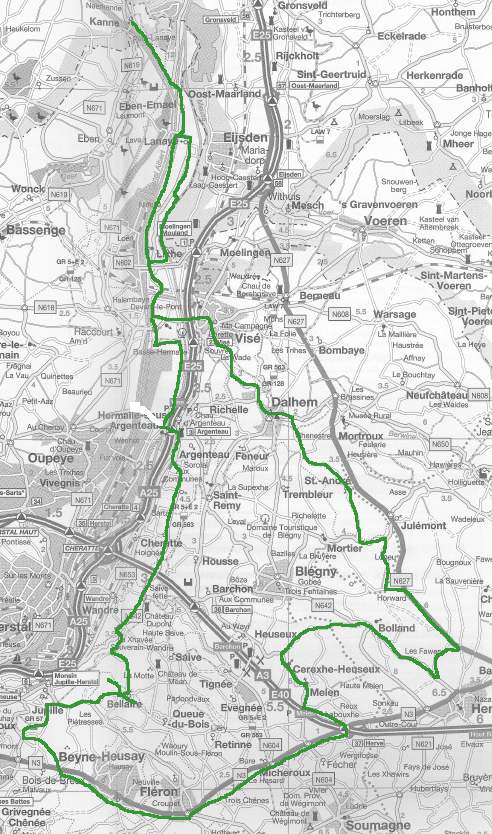
Zondagrondje Mechelse Heide. 12.00 – 14.30. Bewolkt en warm (26 graden?), soms wat zon. Zomers. Weer langs het kanaal & dan door het bos. Thuis de WK kijken. Kanne – kanaal – Rekem – Boorsem – Opgrimbie – Zutendaal – Gelik – Veldwezelt – kanaal – Kanne

cycling,nl | September 24, 2006 | 21:46 | Comments Off on 60 / 2.16 |

Ballard, Kingdom Come & Sorrentino

Just arrived in the post: Ballard’s new novel Kingdom Come. That’ll be my reading matter for the next days — that is, if I managed to tear myself loose from Sorrentino’s Mulligan Stew, a typical postmodern outfit, about an avantgarde novelist trying to write a murder mystery, with his characters discussing their creator. That sort of thing. All about writing and creation. Lots of display of virtuosity, long Joycean lists, lots of verbal invention. The sort of hyper-metafiction that I assumed I was tired of reading, but that turns out to be strangely attractive…

en,reading matter | September 23, 2006 | 20:18 | Comments Off on Ballard, Kingdom Come & Sorrentino |

45 / 1.48

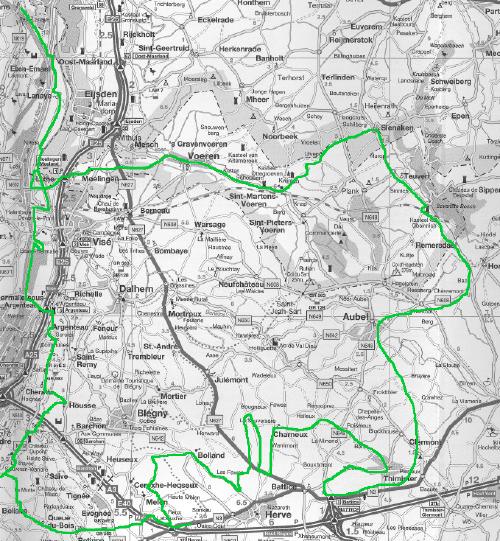
Rustig zaterdag rondje, ging als vanzelf. Omdat het jaapgpad weer probleemloos berijdbaar is (de werkzaamheden aan de brug zijn beëindigd) eens naar het noorden gereden. En zo verrast door de schoonheid van het Maasdal en hoe dichtbij het bos tussen Rekem en Gelik eigenlijk is. Ik was er niet meer geweest sinds, wat, begin juni? Belachelijk warm, zonnig, zelfs benauwd en bijna windstil. Kanne – kanaal – Smeermaas – Rekem – Gelik – kanaal – Kanne

cycling,nl | September 23, 2006 | 20:10 | Comments Off on 45 / 1.48 |

Huge map of the Meuse – Rhine Euregio

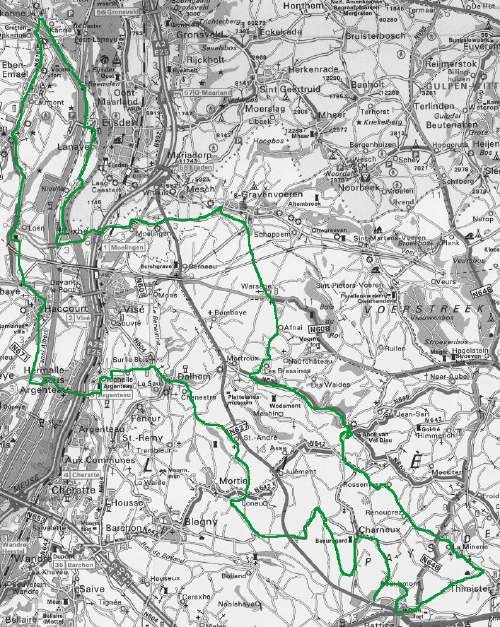
There’s now a huge map of the Meuse – Rhine Euregio on the wall next to my studio at the Jan van Eyck. My neighbour-researchers of the Traces of Autism-project are responsible for it (http://www.janvaneyck.nl/0_3_3_research_info/tracesofautism.html). They have xeroxed all the 1:25.000 maps & glued them together. It’s exactly the area that my cycling-tours cover. The map has my warm attention & I’ve already spent quite some time looking at it, exchanging knowledge about the area with whomever happened to be there.

Here’s Ron Bernstein — also a cyclist — looking at the map.

cycling,en,research | September 22, 2006 | 15:08 | Comments Off on Huge map of the Meuse – Rhine Euregio |
« Previous PageNext Page »
This work is licensed under a Creative Commons Attribution-NonCommercial-ShareAlike 2.5 License. | Arie Altena