Excited & nervous: on sunday Oorbeek will indeed perform with Koichi Makigami, the wonderful Japanese vocalist, (overtone) singer, improvisor, jew’s harp-player: . See: http://www.muziekgebouw.nl/mondharpfestival/. The concert is at the BIMhuis and starts at 15.00.
When I write in reference to Samuels long poem Gewrichten that “I’m tempted to work out the algorithm, the schema, the form, that has generated this particular joining of words” I don’t say that in this way one will capture the meaning or all of the effect of the poem. It’s just a start, as in reading a sonnet, it’s a start to note the form(at): 14 lines, volta, rhyme &c. — and how this informs the effect and the meaning of the poem.
Samuel — who reads my blog — delivers an explanation of his method in the comments: ” I’ll give you the key clue: *every* line appears twice, once indented and once not indented, although in about a quarter of the cases there´s a minor change in the wording. Half of the poem was written as is, the repetitions were done later largely by chance but with an eye to continuity. And there are 480 lines in total. HTH!”
Hmm, so I count badly. (Hey, it was too hot!). 480 makes more sense.
As to reading speed again: quite quickly I found out that Gewrichten forces one to pause for a second after each line. If one does, the musicality ‘comes out’ — the macrostructure builds… Maybe pausing after a linebreak is normal for a lot of readers of poetry — I always think they are slow readers, spending time with each word. But that’s not my way of reading poetry. I start with reading quick through all the lines — often even reading on at every linebreak, for continuity, for getting the sense of the syntax, the rhythm of the sentence (not the line). That way of reading often helps me to understand poetry (afterwards I will spend more time, re-reading, if I like the poem, of when it keeps escaping me). So I had to force the pause after linebreaks (or the poem forced me) … only in the middle, when some lines can be read together, I could speed up.
Upcoming workshop at Mediamatic, from 11-13 september: RFID, Internet of Things: http://www.mediamatic.net/artefact-11944-en.html. There’s a reading list online at http://www.mediamatic.net/article-9691-en.html.
One of the features speakers is, yes, yours truly. Next to Julian Bleecker, http://research.techkwondo.com/ and Timo Arnall, http://www.elasticspace.com/.
“So, yes, writing is my first love and there’s nothing better than really good literature – but art has one advantage in that it provides an active space, a space of becoming-active. You can actually do the thing rather than just represent it. Not if you’re a painter, of course – but in process-based art you can, and that’s a really powerful thing.”
Tom McCarthy, interviewed at http://www.readysteadybook.com/Article.aspx?page=tommccarthy
Visit to the bookstore yesterday made me buy Latour’s Reassembling the Social — http://www.ensmp.fr/~latour/livres/XII_tdmANT.html. Sort of outline of Actor Network Theory (ANT), a term that Latour is now happy to use. Sociology as tracing associations. I read the introductory chapter sitting on the beach of Zandvoort, of all places, early evening, trying to forget the blazing hot sun.
Also read Samuel Vriezen long poem ‘Gewrichten’ (‘joints’) that’s published in this month’s Yang, http://www.yangtijdschrift.be/.. First it seems as if the poem is just loose sentences and bits of sentences, but reading through them, pausing after each line (and each line is clearly a unit), a rhythm develops. Also some lines are repeated. (Samuel is a composer as well & I have been so lucky to be part/performer of his composition Motet; one of his pieces that deals with the rhythm of syntax — that is syntax of language). In the centre of the poem the lines that follow each other do sometimes form sentences together, or at least, can be read as sentences. If I counted right the poem consists of 496 lines, knowing a bit how he composes, and knowing a bit about his taste in poetry, I’m tempted to work out the algorithm, the schema, the form, that has generated this particular joining of words. But I could ask Samuel of course… Needless to say: this is the type of poetry that I love. Art made of language. Not anekdotes put in poetic phrases. (Excuse my wobbly English).
Samuel blogs — in Dutch — at http://blogger.xs4all.nl/sqv/
“In Human Life: Illustrated in My Individual Experience as a Child, a Youth, and a Man (1845), one of his published writings in which diary entries were frequently excerpted, Wright confessed that “writing a journal does me good. I can let off my indignation at the wrongs I see and hear. I am far happier when I write a little every day. I take more note too, of passing events, and see more of what is going on around me. I live less in the past and future, and more in the present, when I journalize . . . It saves me from many dark hours to write down what I see and hear and feel daily. My soul would turn in upon and consume itself, if I did not thus let it out into my journal.”
Right, this time it’s the quote as it appears in W. Caleb McDaniels article at http://www.common-place.org/vol-05/no-04/mcdaniel/index.shtml.
Also copy-pasted this bit — as it connects changes in technology to changes in reading & writing behavior; in the 19th century USA:
“Yet by 1850, this scarcity of print had given way to a bewildering abundance—a rapid growth no less impressive in its own time than the exponential proliferation of blogs in the last few years. Newspapers began to crop up not just in major urban areas but in smaller towns, and as print became more abundant, it was also diffused more widely and rapidly, thanks to a transportation revolution fueled by steam, railroads, and internal improvements like roads, canals, and an expanding postal service. These changes were, of course, not unique to the United States, but even foreign travelers to the young nation were awed by its burgeoning print culture.”
Ann Blair, “Note-Taking as an Art of Transmission” in Critical Inquiry 31, pp. 85-107 (2004).
Of course that’s online, but it’s behind one of those academic fences that one only can pass if one pays a small amount. (How I hate that…). Luckily the Critical Inquiry is available at the Jan van Eyck library.
“The blog provides a means of processing and selecting from an overwhelming abundance of written matter, and of publishing that record, with commentary, for anyone who cares to read it. In some cases, these “readings” become influential in themselves, and multiple readers engage in conversations across blogs. But treating blogging first as a reading practice, and second as its own genre of writing, political or otherwise, is useful in forming a more complete picture of this new/old phenomenon.”
“Perhaps, instead, blogging is the literate person’s new outlet for an old need. In Wright’s [a 19th century diary-writer] words, it is the need “to see more of what is going on around me.” And in print cultures where there is more to see, it takes reading, writing, and association in order to see more.”
Caleb McDaniel at:
http://www.futureofthebook.org/2005/08/the_blog_as_a_record_of_readin.html
(I refered that article in the earlier post on commonplace books. Now I finally read it).
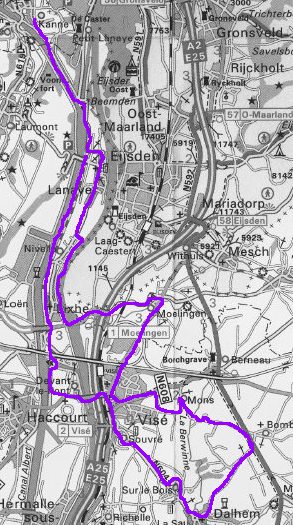
Zomers, hier en daar een wolkje en al (te) warm als ik om kwart voor negen wegrijd. Leuk tochtje om de benen te laten herstellen. Volg voorbij Hermee de grote roze pijlen en vind daardoor een erg mooi glooiend landbouwwweggetje naar Glons.
Kanne – Eben – Halembaye – Froidmont – Houtain St Simeon – Heure L’ Romaine – Grand Aaz – Petit Aaz – Hermee – Fexhe – Glons – Paifve – Wihogne – Xhendremael – Othee – (pik de fietsknooppunten op) – Sluizen – Glons – Bassenge – Wonck – Eben – Kanne

Prachtig zomerweer. Opnieuw om 7 uur opgestaan, om kwart over 8 weggereden. Ik denk dat Huy te ver zal zijn, zeker omdat het warm zal zijn. Ik rij eerst netjes via de fietsknooppuntenroute tot Herstappe (en vraag me af hoe ik er gisteren in slaagde zo volledig verkeerd te rijden — deze route is bijna perfect), volg dan de Jeker tot in Geer, mijn omkeerpunt. Daarna hou ik een zuidelijke koers aan, maar ga meest richting westen dan gepland, zet Huy al uit mijn hoofd als ik, net voor 12 uur, met 68 kilometer op de teller ‘Huy 12’ zie staan. Toch naar Huy. Per ongeluk kom ik op de vierbaansweg terecht, en die volg ik tot in het dal. (Het is allemaal in dalende lijn, en het is rustig, maar het is altijd een vreemd gevoel om op de racefiets op een weg te rijden die weliswaar niet als autoweg is geklasseerd, maar er verder in alles op lijkt). (Natuurlijk had ik de ‘Route Jolie’ moeten volgen). In Huy rij ik de lekker steile St. Leonard op en vraag me af of dat nou de Muur van Hoei is (in mijn wielrenherinnering lopen de Muur van Geraardsbergen, de Citadel van Namen en de Muur van Hoei door elkaar). Ik daal die ook weer af — genoeg kilometers op de teller en ik wil niet helemaal door het dal terug. Via de prachtige klim door het bos van Tihange, de steile klim van Stockay en Les Cahottes terug naar bekend terrein. Het laatste uur is er een beetje teveel aan (warm). In Kanne kijk ik de laatste touretappe en lees vervolgens Frances Wheen’s boekje over Das Kapital (leuk, helder en formuleert kort de actuele aantrekkingskracht en het actuele belang van Marx, wel veel herhaling van de biografie, en een veel te kort boekje voor de prijs), en hoofdstuk 1 van zowel Gissing’s New Grub Street (vermakelijk, erg goed gedaan realisme) als Huxley’s Brave New World (wat stroef…). Wat een zondag maakt van 158 kilometer en evenzoveel boekbladzijden.
Kanne – Eben – Wonck – Bassenge – Boirs – Glons – Rutten – Herstappe – van Eben t/m Herstappe via de knooppunten – Lauw – Otrange – Oreye – Granville – Bergilers – Malpa – Oleye – Waremme – Grande Axhe – Hollonge sur Geer – Geer – Ligney – Tourinne – Les Waleffes – Vaux et Borset – Chapon Seraing – grote weg op – Ampsin – Huy – St. Leonard v.v. – Huy – Tihange – Bois de Tihange – Rawsa – Ombret – Pont de Hermalle – Stockay – Tincelle – Awirs – Les Cahottes – Lexhy – Roloux – Fexhe le Haut Clocher – Fooz – Villers L’Eveque – Xhendremael – Juprelle – Slins – Houtain st. Simeon – Bassenge – Wonck – Eben – Kanne