Dreaming of a Dynabook, 1977

‘Imagine having your own self-contained knowledge manipulator in a portable package the size and shape of an ordinary notebook. Suppose it had enough power to outrace your senses of sight and hearing, enough capacity to store for later retrieval thousands of page-equivalents of reference material, poems, letters, recipes, records, drawings, animations, musical scores, waveforms, dynamic simulations, and anything else you would like to remember and change.’

Allan Kay & Adele Goldberg, ‘Personal Dynamic Media’, Computer 10 (3): p. 31-41, March 1977. (Quoted from Wardrip-Fruin & Montfort (eds.) The New Media Reader, MIT Press, Cambridge &c, 2003, p. 394.)

We have that, don’t we.

en,quotations,research,ubiscribe | June 1, 2006 | 11:43 | Comments Off on Dreaming of a Dynabook, 1977 |

Tourette III

New issue of Will Stuart’s samizdat mag Tourette (Black Rainbow) will be presented next week, tuesday june 6th at De Appel in Amsterdam, from 19.00h on. Expect fotocopied quality text & image that will tickle & soothe the brain. (Or something like that). — It’s not for sale! (But voluntary donations are of course welcome).

I’d say this is another direction which publishing is taking. No distribution, non-commercial, cheap, but high quality content + excellent choice of material. And sort of operating on the brink of copyright-legislation. (Like old-fashioned xeroxed magazines?)

It’s not directly print-on-demand, on the other hand: I’d be interested to obtain a print-out of material that Will Stuart thinks is interesting… I’d give them a voluntary donation for selection + the effort of printing out. (The re-invention of publishing?) So in that sense it is similar to ‘print-on-demand’.

en,free publicity,reading matter,ubiscribe | June 1, 2006 | 10:47 | Comments Off on Tourette III |

Ubiscribe presentation

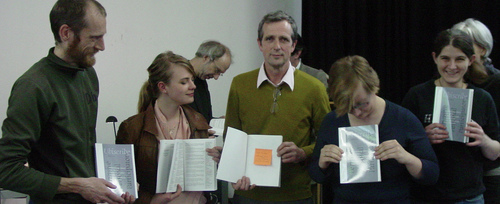
This is already from last week (21th May): the presentation of the Ubiscribe POD. Only now I’m beginning to realize what we’ve done…

PS, left to right: your blogger, Inga Zimprich, Jouke Kleerebezem, Sandra Fauconnier, Claudia Hardi.

en,free publicity,research,ubiscribe | May 31, 2006 | 13:06 | Comments Off on Ubiscribe presentation |

Another bit of Nelson

‘[…]
As far as I know, there is still not a Decent Writing System anywhere in the world, although several things now come close. It seems a shame that grown men and women have to rustle around in piles of paper, like squirrels looking for acorns, in search of the phrases and ideas they themselves have generated. The decent writing system, as I see it, will actually be much more: it will help us to create better things in a fraction of a time, but also keep track of everything in better and more subtle ways than we ever could before. […]’

Quote from Nelson’s Dream Machines, 1974, as found on http://www.mprove.de/diplom/ht/tndm.html.

en,quotations,research,ubiscribe,writing | May 19, 2006 | 12:39 | Comments Off on Another bit of Nelson |

Xanadu

Of course he’s mad, but he also truly is a hero: Ted Nelson. Searching for images in a last attempt to contribute to this weekend’s Tomorrow Book-project, I land at Nelson’s Xanadu-page. You have to love this:

PROJECT XANADU MISSION STATEMENT:
DEEP INTERCONNECTION, INTERCOMPARISON AND RE-USE
Since 1960, we have fought for a world of deep electronic documents — with side-by-side intercomparison and frictionless re-use of copyrighted material.
We have an exact and simple structure. The Xanadu model handles automatic version management and rights management through deep connection.

Today’s popular software simulates paper. The World Wide Web (another imitation of paper) trivializes our original hypertext model with one-way ever-breaking links and no management of version or contents.

WE FIGHT ON.

http://www.xanadu.net/

And wouldn’t it be beautiful to have “deep quotable hypertext”… if only for the terminology…

Xanadu, in development since the 1960s, never took off. I wonder what Nelson thinks about what is happening now, with blogsoftware automatically sending out (meta-)information, that is aggregated by services like Technorati.

en,quotations,research,software,ubiscribe | May 19, 2006 | 12:32 | Comments Off on Xanadu |

Jan van Eyck Book Weekend

Next weekend = Jan van Eyck Book Weekend. With a.o. a Tomorrow Book Projects Workshop; Stuart Bailey’s Manifesta print-on-demand shop, Gerhard Rühm (really!!), lots of Fluxus and Concrete Poetry books on display, and more;

and then of course, on sunday, 15.00 hrs. the presentation of Ubiscribe PoD 0.9.0, the publication we (Jouke, Sandra, Claudia, Inga & me) have been working on in the past 2 weeks — starting with putting content (text, images) into our wiki, ending, temporarily, with a paper publication. (In the wiki one can find already new stuff added). I just send some last corrections to Jouke. Tomorrow morning the pdf will be at the printers. Launch & learn is the term we’ve devised for this kind of ultra-quick production. It’s like learning to understand again/anew what editing is, what ‘editorial labor’ entails.

Programme for 20/21th May: http://www.janvaneyck.nl/0_2_3_events_info/arc_06_bookish_weekend.html.

blogging,en,free publicity,research,ubiscribe | May 14, 2006 | 20:50 | Comments Off on Jan van Eyck Book Weekend |

Reading through my own blog for Ubiscribe

Yesterday I read through my own blog: intuitive datamining for a small Ubiscribe-publication: http://www.ubiscribe.net.

‘Intuitive datamining’: clicking through the archive, quickly scanning the entries with a human brain, then remembering what I’d been writing about, subsequently finding a few bits that might be interesting to re-publish in a small print-on-demand publication.

We — the (a?) Ubiscribe-team consisting of Jouke Kleerebezem, Sandra ‘Fokky’ Fauconnier, Inga Zimprich, Claudia Hardi and myself — are filling a wiki with ‘stuff” (text, pictures), to be ‘back-upped’ on paper as version 0.9. Publication-on-paper to be presented on 21th of May, at the Jan van Eyck. For all of us the process as a whole (gathering – writing – uploading – tagging – editting – commenting – designing – ‘outputting’ on paper) is a new experience. Though any of us know part of the process, but not the same parts.

Research what publishing is, by publishing.

blogging,en,research,ubiscribe | May 3, 2006 | 13:08 | Comments Off on Reading through my own blog for Ubiscribe |

Blogging advise from 2002

How American:

‘[Blogging]has given me the practice in performing imperfectly in public and moving forward unashamed. Updating my site daily has taught me self-discipline and given me reason to think deeply. I am a better writer.’ p. 29

Put it on a tile:

‘The happiness you derive from your weblog will depend on your interest, your ability to devote sufficient time to the project, and your commitment to keeping the rest of your life in balance.’ p. 35

Quotes from Rebecca Blood’s 2002 Weblog Handbook. I reread it earlier this week, and typed over these quotes. This sort of advise sounds ‘terribly American’ to most European ears; yet I cannot but agree. And she is still blogging (old-style): http://www.rebeccablood.net.

Well, do I really agree? I do agree with the second statement. I would like to believe that the first one is true as well, but I am not so sure that blogging functions a tool or a reason to learn to think deeply… I’d say one can find counter-examples.

blogging,en,ubiscribe,writing | April 30, 2006 | 14:17 | Comments Off on Blogging advise from 2002 |

Foucault, What is an Author

‘We can easily imagine a culture where discourse would circulate without any need for an author. Discourses, whatever their status, form or value, and regardless of our manner of handling them, would unfold in the anonimity of a murmur.’ How Agamben quotes Michel Foucault, ‘ What is an Author’ in the english translation Remnants of Auschwitz, 2002. (Text states: ‘translation emended).

‘Although since the eightteenth century, the author has played the role of the regulator of the fictive, a role quite characteristic of our era of industrial and bourgeois society, of individualism and private property, still, given the historical modifications that are taking place, it does not seem necessary that the author function remain constant in form, complexity, and even in existence. I think that, as our society changes at the very moment when it is in the proces of changing, the author function will disappear, and in such a manner that fiction and its polysemous texts will once again function according to another mode, but still with a system of constraint (…). All discourses, whatever their status, form, value, and whatever the treatment to which they will be subjected, would then develop in the anonimity of a murmur.’ Michel Foucault, ‘What is an Author’, in Essential Works of Foucault 1954 – 1984, vol 2, Aesthetics, p. 222

en,research,ubiscribe,writing | April 29, 2006 | 18:55 | Comments Off on Foucault, What is an Author |

Things done

First spent time revisiting blog-theory anno 2002 (like Rebecca Blood’s The Weblog Handbook: http://www.rebeccablood.net/handbook/). I made some notes on yellow post-its.

Then went through folders on my harddisk in which I have stored webpages and pdfs ‘to read’; re-ordered the contents (I now have 4 different research folders), deleted some, printed the papers I really want/have to read this week.

After that I made an old-fashioned links-page, and visited (quickly) about 100 (?), 200 (?) blogs to see if I want to include them on this page (for further reference, to remember). I worked through VoodooPad-documents in which I had saved links, went though the linkslist of my ‘old’ blog, followed links on blogs that I was happy to revisit or rediscover, and, most importantly, used my own memory. I still have to go through the bookmark-files of both Firefox and Safari — I only bookmarks when I’m too lazy to do more than hit ‘command-D’ (so the bookmark-lists tends to be long and totally unorganized).

Will this compulsion to order lead anywhere?

I never really go to use delicious/ariealt. Although I do use the delicious-accounts of others, often to good result. What one uses or not, has a lot to do with, well, preferences. (What you like, what you’re good at, what fits your use if time and working methodology, how important design is, how important good writing, etc.).

I also don’t use RSS. (My blog does RSS though, and I know some people appreciate that). I used RSS for a while when I spent much time on trains. Before catching a train I would boot my RSS-reader, let the feeds stream onto my harddisk, to browse through on the train. RSS was / is a way to have online content when there’s no connection. (I hated blogs that only put a headline plus a lead in the RSS, or worse, only a headline). What I miss in RSS is the personality of the design, the typography, all that (subtle? — hopefully) visual stuff that adds to the ‘voice’ of the site.

Wrt design: there is a strange attraction to making all texts look the same: have it shown in the stylesheet / template of your choice. (But basically RSS-readers and services like Bloglines (http://www.bloglines.com/) do not really look attractive).

I am put-off by really bad design. (That’s what I learned from visiting 100 blogs tonight, and quickly closing those which looked really ugly). But I’m not put off by generic Blogger/Wordpress/MoveableType-templates, as long as they are (a bit) clear.

Links-page and notes to come…

Here’s some of what I printed to read:
http://blog.lib.umn.edu/blogosphere/.
blogging,en,research,software,ubiscribe | April 26, 2006 | 14:10 | Comments Off on Things done |
« Previous PageNext Page »
This work is licensed under a Creative Commons Attribution-NonCommercial-ShareAlike 2.5 License. | Arie Altena