There was no chance for live blogging at the SLSA-conference.
Here’s what I typed at some point: “No, no live blogging, and how I miss being able to quickly check something online, find a reference, an answer to a question, the name of an author mentioned, while listening to a presentation. How I miss multitasking, just reading some blogs while listening. How I miss it, to write down my notes in a disciplined way, and upload, while listening: my mind will not wander that much. But there is no airport here, not for me. And a marked difference between new media conferences and the academic world is that almost nobody here is using a laptop during sessions, which make me think I am not playing by the rules here when I have my laptop open and start typing.”
‘Ein neuer Service im Netz war früher an der Idee der Software orientiert, eine halbwegs stabile Versionsnummer rauszubringen. Heutzutage ist alles, gerne auch beliebig lange, Beta.’
Sacha Kosch, WEB 2.0 Einleitung, in Debug 98, http://www.de-bug.de/texte/4137.html.
(I’m reading through 2 years of DeBug issues).
PS, the catchword is of course ‘perpetual beta’. Knew that, but some things one forgets when reading a different language.
http://decodeunicode.org/; a wiki with about all the unicode-characters! So, thousands and thousands an thousands of characters from all written languages.
‘Imagine having your own self-contained knowledge manipulator in a portable package the size and shape of an ordinary notebook. Suppose it had enough power to outrace your senses of sight and hearing, enough capacity to store for later retrieval thousands of page-equivalents of reference material, poems, letters, recipes, records, drawings, animations, musical scores, waveforms, dynamic simulations, and anything else you would like to remember and change.’
Allan Kay & Adele Goldberg, ‘Personal Dynamic Media’, Computer 10 (3): p. 31-41, March 1977. (Quoted from Wardrip-Fruin & Montfort (eds.) The New Media Reader, MIT Press, Cambridge &c, 2003, p. 394.)
We have that, don’t we.
Close Encounters is thet title of the conference where I’ll be speaking for 20 minutes on wednesday 9.00-10.30, in a panel with Tobias van Veen and Trace Reddell. Tobias asked me to propose a paper in the panel that he and Trace Reddell were proposing & we got accepted: http://www.slsa.nl.
So more than 10 years after my 4-year stint as PhD student at the University of Amsterdam ended, “I’ll be back”. Richer qua experience, being more & widely well-read and with a string of published articles in my bag. But also: not having written anything for an academic magazine ever (hmm, or does writing a review for Krisis count?). Also I have never spoken at an academic conference. I am looking forward to 3 days of listening to papers. I hope I will be able to do some live blogging.
Btw, I will be speaking about blogs & mp3-blogs, memory, hoarding, mixing and the transformation of, well, the culture of enjoying music. (Still have to find the right words, les mots justes).
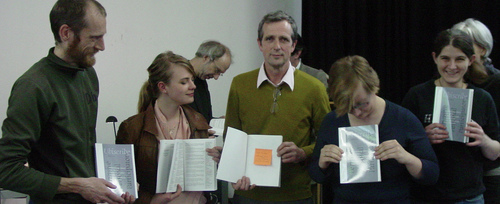
This is already from last week (21th May): the presentation of the Ubiscribe POD. Only now I’m beginning to realize what we’ve done…
PS, left to right: your blogger, Inga Zimprich, Jouke Kleerebezem, Sandra Fauconnier, Claudia Hardi.
Have to start writing down the actual sentences for my text about the electronic/multimedia/internet/new media-poetry shown at De Waag last week. But I click’n read from poetry-blog to poetry-blog. Making the rounds: the weekly ones (a.o. Mettes: http://n30.nl/poezienotities.html, Contrabas: http://www.decontrabas.com/, Silliman), the monthly ones (Inwijkeling: http://reugebrink.skynetblogs.be/), and checking out what has happened in the e-poetry scene in the past months.
I read the discussions about Dirk van Bastelaere’s new book. Van Bastelaere was (is?) definitely one of my favorite poets. There are not many poems that I have read as often as those in Pornschlegel and Diep in Amerika. Yet I was disappointed by Hartswedervaren and Van Bastelaere’s current theoretical interests (Lacan…) are certainly not mine. And yet, even the poems in Hartswedervaren, I think, are stronger than those of Stefan Hertmans (who’s much milder, & whom I also continue to follow), or the much-praised Peter Verhelst, whose work to me always has seemed to be artificial and ‘unreal’ (‘gewild’ — tho that’s a very problematic criticism… I know). Hmm. anyway, I have to get a copy of Van Bastelaere’s de voorbode van iets groots today — so I can give my 2 cents…
I read Silliman on the poetics of Charles Olson — a very nice piece: http://ronsilliman.blogspot.com/2006/05/breathe-say-all-manner-of-meditators.html. Olson’s ideas about breath and projective verse are another ‘topic’ that I keep going back to (or ending up with?)
But what is this… research? Or am I postponing the moment to ‘jot down’ the first real draft of my text.
Reading through De Certeau’s book, checking if there’s anything that I should read or reread (I read a few chapters in the past). Struck by the fact that De Certeau is all the time assuming the existence of power-structure/master-discourse, against which the people/users devise their own counter-strategies. In that way a common poetics will always be defined as something which insinuates itself inside, is set up against, that which is in ‘power’. (Does this make sense — or have I been reading too quickly?)
‘Reading is thus situated at the point where social stratification (class relationships) and poetic operations (the practitioner’s constructions of a text) intersect: a social hierarchization seeks to make the reader conform to the “information” distributed by an elite (or semi-elite); reading operations manipulate the reader by insinuating their inventiveness into the cracks in a cultural orthodoxy.’ Michel de Certeau, ‘Reading as Poaching’, inThe Practice of Everyday Life, University of California Press, Berkeley etc., 1984, p. 172
‘[…]
As far as I know, there is still not a Decent Writing System anywhere in the world, although several things now come close. It seems a shame that grown men and women have to rustle around in piles of paper, like squirrels looking for acorns, in search of the phrases and ideas they themselves have generated. The decent writing system, as I see it, will actually be much more: it will help us to create better things in a fraction of a time, but also keep track of everything in better and more subtle ways than we ever could before. […]’
Quote from Nelson’s Dream Machines, 1974, as found on http://www.mprove.de/diplom/ht/tndm.html.
Of course he’s mad, but he also truly is a hero: Ted Nelson. Searching for images in a last attempt to contribute to this weekend’s Tomorrow Book-project, I land at Nelson’s Xanadu-page. You have to love this:
PROJECT XANADU MISSION STATEMENT:
DEEP INTERCONNECTION, INTERCOMPARISON AND RE-USE
Since 1960, we have fought for a world of deep electronic documents — with side-by-side intercomparison and frictionless re-use of copyrighted material.
We have an exact and simple structure. The Xanadu model handles automatic version management and rights management through deep connection.
Today’s popular software simulates paper. The World Wide Web (another imitation of paper) trivializes our original hypertext model with one-way ever-breaking links and no management of version or contents.
WE FIGHT ON.
http://www.xanadu.net/
And wouldn’t it be beautiful to have “deep quotable hypertext”… if only for the terminology…
Xanadu, in development since the 1960s, never took off. I wonder what Nelson thinks about what is happening now, with blogsoftware automatically sending out (meta-)information, that is aggregated by services like Technorati.