35,5 1.30
20.00 – 21.30 Prachtig weer & warm. Avondrondje voor t donker. Kanne – St. Pierre – Halembaye – Froidmont – Heure L’ Romaine – Rue Fragnay – Houtain St. Simeon – Bassenge – Moulin Broukay – Eben Emael – Kanne
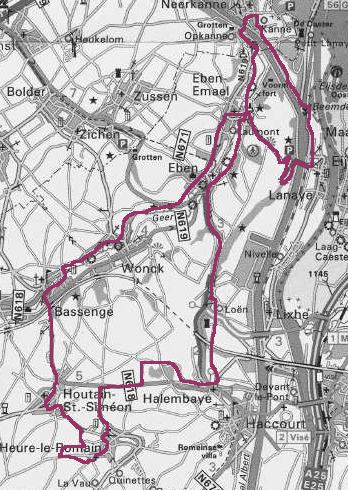
20.00 – 21.30 Prachtig weer & warm. Avondrondje voor t donker. Kanne – St. Pierre – Halembaye – Froidmont – Heure L’ Romaine – Rue Fragnay – Houtain St. Simeon – Bassenge – Moulin Broukay – Eben Emael – Kanne
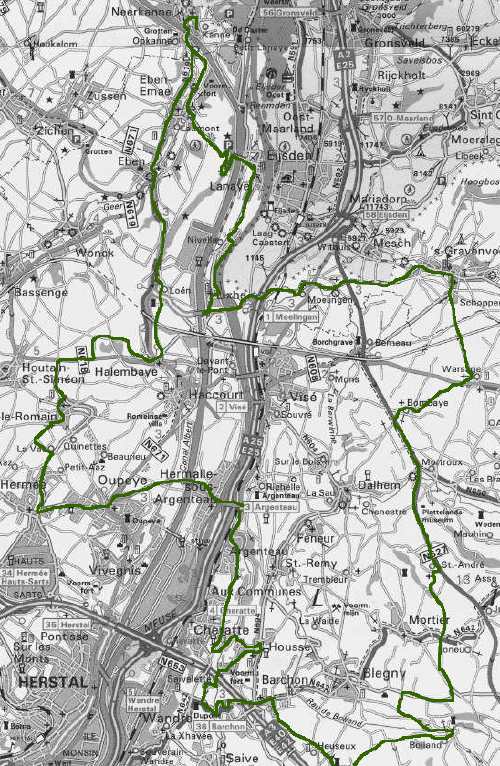
En soms heb je gewoon zin om te rijden, al is het koud en al worden er buien verwacht. De zon scheen boven verwachting bijna de hele middag — na een vroege ochtend met regen. 16.30 – 19.30, veel zon, vrij koud (graad of 10?). Kreeg tussen St. André en Moelingen inderdaad een flinke, trouwens erg koude, bui op mn kop. Verderop scheen de zon, mijn fiets zat toch al onder de modder, en gegeven zulke omstandigheden vind ik een flinke bui eigenlijk niet zo erg, hmm, ook wel lekker… Mooie route, nu eens wat klimmetjes opgezocht en op goed geluk wat weggetjes ingeslagen. Kanne – Eben Emael – Halembaye – Haccourt – Froidmont – Heure le Romain – Rue Fragnay – Hermée – Oupeye – Hermalle sous Argenteau – Sarolay – ri. Housse – ri. Wandre – Barchon – Heuseux – Bolland – ri. Blegny – bijna bij de top ra. – daarna weer ra. – la. – ra. mooie kleine weg in – Saint – Andre – Mortroux – Bombaye – Warsage – ‘s Gravensvoeren – Moelingen – Lixhe – Lanaye – St. Pierre – Kanne
How American:
‘[Blogging]has given me the practice in performing imperfectly in public and moving forward unashamed. Updating my site daily has taught me self-discipline and given me reason to think deeply. I am a better writer.’ p. 29
Put it on a tile:
‘The happiness you derive from your weblog will depend on your interest, your ability to devote sufficient time to the project, and your commitment to keeping the rest of your life in balance.’ p. 35
Quotes from Rebecca Blood’s 2002 Weblog Handbook. I reread it earlier this week, and typed over these quotes. This sort of advise sounds ‘terribly American’ to most European ears; yet I cannot but agree. And she is still blogging (old-style): http://www.rebeccablood.net.
Well, do I really agree? I do agree with the second statement. I would like to believe that the first one is true as well, but I am not so sure that blogging functions a tool or a reason to learn to think deeply… I’d say one can find counter-examples.
But who cares? I spent part of this afternoon clicking and reading through the reports about how many weblogs there are now, worldwide and in the Netherlands, how many links they receive, how large their impact is on the MSM (to use the old blogosphere code for mainstream media). Yes, also I downloaded the pdf with the powerpoint-presentation of Paul Molenaar for Blogonomics 6, — via http://www.denieuwereporter.nl/?p=405 which contains the information that there are now about 600.000 bloggers in the Netherlands — of which 260.000 use web-log.nl, the horrible (imho) blogsoftware of Ilse (is it? I’m too lazy to even check). The powerpoint presentation is full of Fokke and Sukke cartoons.
Why am I so bored by this? Because it’s in the end only about numbers. Numbers which are important for old-world investers and advertisers.
3 loose, maybe stupid remarks, between brackets:
(1. Is that why the 260.000 of web-log.nl are mentioned?). (2. Probably anybody in the Netherlands doing a lot of surfing has stumbled many times on web-log.nl-blogs that turn out to not exist, the link exists, the blog doesn’t). (3. During Blogonomicsweb-log.nl is about blond models in tight T-shirts, as can be seen here: http://www.loiclemeur.com/english/2006/04/exhausting_afte.html).
Another reason for my boredom is that in such reports and business-confernces like Blogonomics, (still) the old mass-media and journalism function as the main contexts. (Why count how many links blogs make to the old mass-media?) Of course there is still a big role for the ‘major players’ (like Guardian, BBC etc.). But you do not establish insight into that role by counting how often blogs refer to those major players. Oh well, or maybe it does.
(It sure isn’t accidental that after a week with lots of blogging about MySpace — at least I saw a few postings about MySpace, all refering to the same issues — both De Volkskrant and NRC have articles about MySpace. That’s not strange, that’s how journalism works).
The research of how stories travel through a network of interlinked sites — like the research done by Anjo Anjewierden http://anjo.blogs.com/metis/, is lots more interesting (again, immnsho).
Also much more interesting is Geert Lovink’s proposal (I know, I’m late to link…): http://www.networkcultures.org/geert/2006/03/24/blogging-the-nihilist-impulse/. He writes: “Blogs bring on decay. Each new blog adds to the fall of the media system that once dominated the twentieth century. What’s declining is the Belief in the Message.” I might be less nihilisticly-inclined than Geert. I’d like to stress the ‘constructing of a ‘new’ culture’ (which is not utopian, but a big mess….) instead of focussing on how that dismantles the old — but that might, in the end, be mostly a difference in rhetoric and style…
Trying to get into the top 100 of Technorati is subscribing to the logic of mass media. (And indeed, it’s missing the point about publishing online).
I’m beginning to ramble. Can’t make it cohere. (As Ez sez). It’s not really my field. I learned much more today from reading bits of the bookhistorian Roger Chartier. Amazon links to: Order of Books and Forms and Meaning. Discovered that by hitting ‘surprise me’ you can get many more pages to read ‘inside’.
‘We can easily imagine a culture where discourse would circulate without any need for an author. Discourses, whatever their status, form or value, and regardless of our manner of handling them, would unfold in the anonimity of a murmur.’ How Agamben quotes Michel Foucault, ‘ What is an Author’ in the english translation Remnants of Auschwitz, 2002. (Text states: ‘translation emended).
‘Although since the eightteenth century, the author has played the role of the regulator of the fictive, a role quite characteristic of our era of industrial and bourgeois society, of individualism and private property, still, given the historical modifications that are taking place, it does not seem necessary that the author function remain constant in form, complexity, and even in existence. I think that, as our society changes at the very moment when it is in the proces of changing, the author function will disappear, and in such a manner that fiction and its polysemous texts will once again function according to another mode, but still with a system of constraint (…). All discourses, whatever their status, form, value, and whatever the treatment to which they will be subjected, would then develop in the anonimity of a murmur.’ Michel Foucault, ‘What is an Author’, in Essential Works of Foucault 1954 – 1984, vol 2, Aesthetics, p. 222
En soms heb ik gewoon geen zin om een tochtje te maken. Te koud, wat anders aan mn hoofd, werk te doen, en vooral: gewoon geen zin. De hele dag zit ik in mn ‘studio’ op de Jan van Eyck, lees halve boeken, verzamel citaten, klik door blogs; en zie dat het helemaal niet zulk slecht weer is (ja het is koud, maar niet zo koud…). Vandaag heb ik gewoon geen zin om een tochtje te maken.
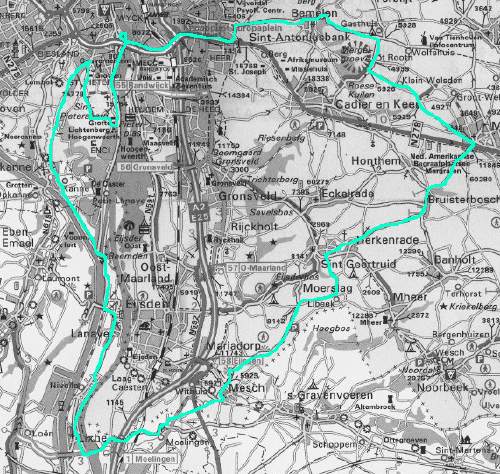
19.30 – 21.10 Lekker gereden, maar koud. Een weekend met slecht weer in het vooruitzicht. Kanne – Lanaye – Moelingen – Mesch – St. Geertruid – Bruisterbosch – Margraten – Bemelen – Maastricht – Zonnenberg – Kanne. Volgende keer zoek ik weer wat meer klimmetjes op.
James Joyce Ulysses, in the first Dutch translation by John Vandenbergh, published 1969, hardcover, in cassette, together with Aantekeningen bij James Joyce’s Ulysses by the same John Vandenbergh. This is the edition that I first encountered Joyce in, around 1980 — maybe even earlier –, at the house of my grandparents, where my uncle H., (who was then about 20 years old) showed me the big blue book, telling me this was sort of a 20th century Odyssee, set in Dublin. I was intrigued of course. Became even more intrigued after seeing a page from Finnegans Wake in the Spectrum Encyclopedie.
I read Ulysses for the first time in this Dutch translation (a few years later). (I remember at that time any book translated by either John Vandenbergh or Gerardine Franken was a recommendation, like for instance Faulkner’s Absalom, Absalom, of which, I remember, I did not understand a word, but finished reading to the last page nonetheless).
‘Statig kwam de vlezige Buck Mulligan van het trapgat, in de handen een bekken vol schuim waarop kruiselings een spiegel en een scheermes.’
This afternoon I came across a copy of just this book at a second hand bookstore. (For the non-Dutch, this translation is not available anymore, since the Paul Claes & Mon Nys translation came on the market). Complete, in cassette, perfect condition. I bought it. (37,50). It even has the smell of the library books through which I first encountered literature. It’s as if I’ve always had a copy of this book.
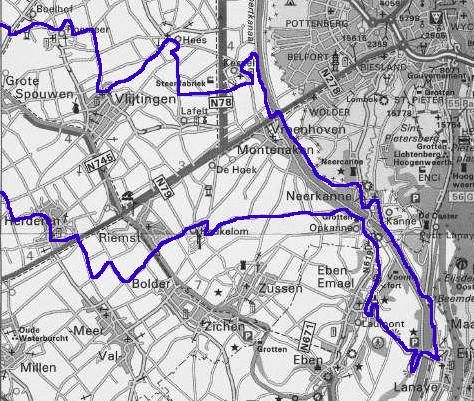
19.00 – 21.00. Mooi avond, maar ik kwam niet vooruit. Zo’n tochtje waarbij je steeds afvraagt of de remblokjes niet tegen de velg lopen. Ik volgde de fietsknooppunten, 95% over betonplaatweggetjes. Draaien en keren om elk dorp heen en mn fiets dus onder de modder. Te snel terug in Kanne en nog een rondje over de St. Pierre gemaakt. Kanne – Muizenberg – Vroenhoven – Vlijtingen – Rosmeer – Riemst – Heukelom – Zusserdel – Eben-Emael – St. Pierre – sas – Kanne
This is what I call culture. ;-) http://www.oldskooltrack.com/.