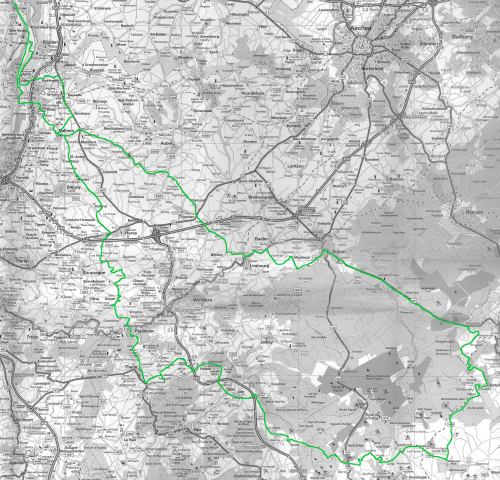
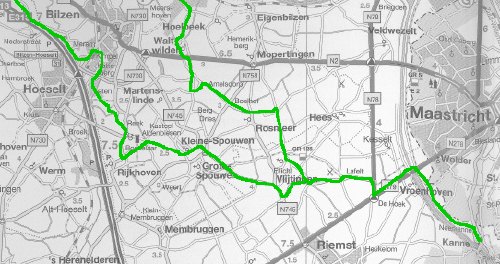
97 / 4.54

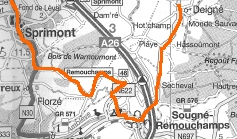
Eerst Dewey lezen, dan fietsen. In de ochtend flink wat regen, later ook opklaringen, om 15.00 op de fiets, en een groot deel in de zon gereden, drie kleine buien, redelijk fris, heerlijk fietsweer. Fikse zuidenwind. Een perfecte dag om wat Houtepenklims te doen. Echt vermaak voor de zondag — wanneer de Luikse wegen heel rustig zijn. (De gemiddelde snelheid kruipt wel naar onder de 20, ook door al het zoeken, en op de terugweg ging de Veille Voie niet echt makkelijk meer). Het is inderdaad een prachtig gebied… soms hetzelfde stukje heen en weer gereden. Rue Melard, Cote de Bois des Dames (toch? de klim naar links), Rue Tesny, Rue Bois Sauvage (na Rue Marchon — loopt dood), Bellaire / Fleron, Rue Heids de Chene (nu met spiksplinternieuw asfalt, maar niks makkelijker, Angliru-herinneringen), Rue Haute Folie, Veille Voie Bellaire, langzame klim vanuit Jupille door het bos, Veille Voie (Cheratte), Wihxou — heel klein paadje, met bord ‘doodlopende weg’, naast de friterie (tot nu toe over het hoofd gezien…). De route zit vol heen en weer, doodlopende wegen inrijden en ik heb geen idee of ik de route juist heb ingetekend. Maar het was genieten. (En zo’n zestal ‘echte’ Houtepenklims op 1 tocht is echt genoeg, voor mijn benen dan…)

Kanne – kanaal – Maas – Hermalle ss Argenteau – Cheratte – Voie Melard (verboden in te rijden, eigenlijk een soort voetgangerspad naar boven) – Cheratte – Veille Voie af – Wandre – Cote de Bois de Dames (linksom omhoog en ook weer afdalen) – Rue Tesny (schitterend) – Jupille – beetje links aanhouden, wandelgebied in – Rue Marchon (na wat zoeken, volg de groene B+pijl — mountainbikeroute, de Rue Marchon loopt dood, maar heet uitzicht is prachtig), omkeren, nu de rue Bois Sauvage in, bij splitsing rechtdoor (linksaf loopt dood) – door het rommelige bos afdalen, v.v. omhoog en weer afdalen – klim naar Bellaire – Fleron – afdalen richting Jupille – linksaf Rue Heids de Chene – Fleron – afdaling naar Vaux ss Chevremont – even rechts naar Beyne en via L38 fietsroute (hier verhard) weer terug – Vaux ss Chevremont – Rue Haute Folie – abdij Chevremont – Rue des Gottes – Magnee – Fleron (op een of andere manier achterlangs via fietspad) – afdalen ri. Jupille – rechtsaf Rue Veille Voie Bellaire (steil maar makkelijk) – Jupille – klim naar Wandre – Bois les Dames – Cheratte – Veille Voie – Sarolay – Argenteau – Whixhou – Argenteau – Vise – kanaal – Kanne

cycling,nl | August 21, 2006 | 18:12 | Comments Off on 97 / 4.54 |

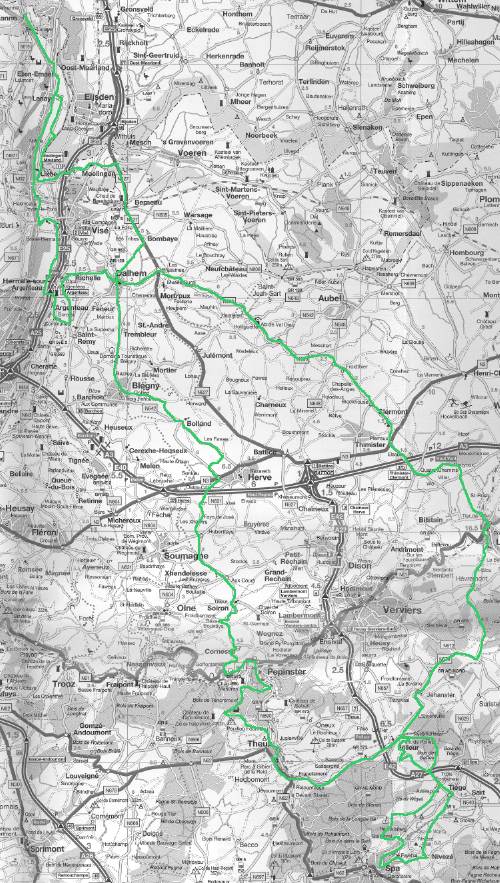
150 / 6.50

Eerst Dewey lezen (Reconstruction in Philosophy — prachtig & glashelder), dan fietsen. Schitterend zomerweer, eerst erg warm (27 graden?) en zonnig, later veel bewolking en hier en daar een zeer lokale bui — je zou er in 2 minuten doorheen rijden, zo lokaal. Ik voel slechts een paar sputters. 13.00 – 20.00. Raar rondje, ik was helemaal niet van plan om lang door het bos te rijden, maar deed het toch. Ditmaal over Henri-Chapelle gereden, waar een familiefietstocht gaande was en honderden mensen in oranje T-shirts zich vanuit Verviers naar boven hesen, dan via Welkenraedt en tja, dan zit je dicht bij Eupen…

Kanne – Lanaye – Moelingen – Gravensvoeren – fietspad achterlangs – Schophem – St. Martensvoeren – St. Pietersvoeren – Veursbos – Aubel – Henri-Chapelle – Welkenraedt – Membach (via de fietsknooppunten, erg slechte en modderige weg, maar je komt er wel onder de snelweg en TGV mee door (de weg over Baelen is nog altijd afgesloten) – Eupen – stuwmeer – dan, meest de knooppunten volgens om het meer en vervolgens dwars door het Hertogenwoud om uiteindelijk in Goe uit te komen – Goe – Hevremont – Limbourg – Clermont – Froidthier – Val Dieu – Mortroux – Warsage – Gravensvoeren – Mesch – Oost-Maarland – Maastrich – (euh, ik had de boodschappen op de Jan van Eyck laten staan, en vervolgens met groenten, worst en eieren onder in mn trui als pakezel naar huis) – Kanne.

cycling,nl | August 21, 2006 | 18:10 | Comments Off on 150 / 6.50 |

61,5 / 2.42

Veel wind, zuidelijk. Felle zon en wolken. Redelijk warm (23 graden). Vreemd weer. Eerst werken dan fietsen, en daar tussenin eindelijk weer ‘ns een uurtje lekker in de zon lezen. Kanne – Lanaye – Moelingen – Gravensvoeren – Martensvoeren – St. Pietersvoeren – Aubel – Froidthier – Les Trixhes – Val Dieu – Mortroux – Dalhem – Vise – kanaal – Kanne

cycling,nl | August 21, 2006 | 18:09 | Comments Off on 61,5 / 2.42 |

85 / 3.54

Eerst werken, dan fietsen. 16.30 – 20.30. Laten we zeggen: een toeristisch rondje — wat wil zeggen dat ik hier en daar op goed geluk een weggetje in sla, geen doel heb, geen route plan, en ook nog foto’s maak. Het is verrassend warm (25 graden?), eerst zonnig, later bewolkt.

Kanne – kanaal – Visé – Lorette – Dalhem – Mortroux – Val Dieu + RA klimmetje (net voor Val Dieu, loopt dood) – Rossenfosse – ri., Charneux – Battice (via een klim die ik niet kende) – La Minerie – Thimister – Clermont – Froidthier – La Bushaye – Aubel – St. Pietersvoeren – Martensvoeren – Gravensvoeren – Moelingen – Lixhe – Lanaye – Kanne

cycling,nl | August 18, 2006 | 11:20 | Comments Off on 85 / 3.54 |

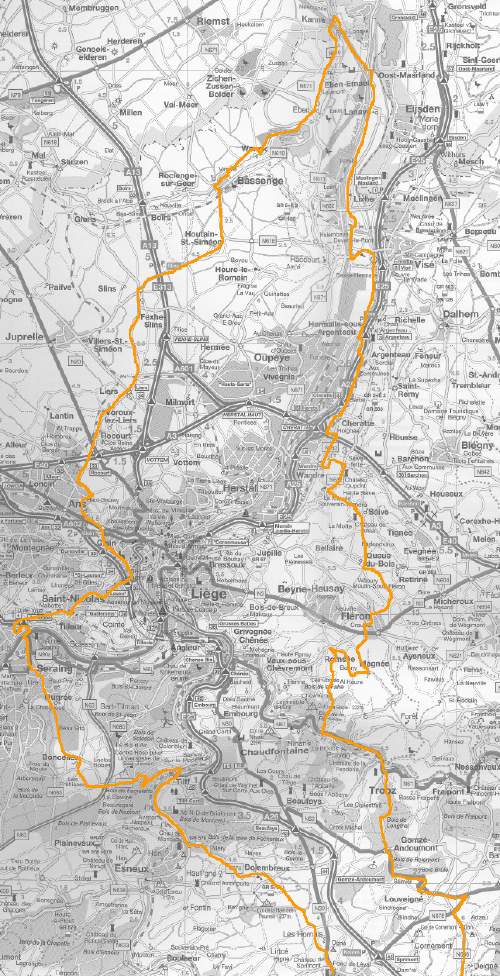
142 / 6.16

Moe na 2 dagen Brussel. 11.00 – 18.00. Vakantiedag. De weersvoorspellingen zijn helemaal niet slecht: tot 25 graden en kans op een bui in de middag als er stapelwolken ontstaan. De weersvoorspellingen kloppen: voorbij Luik hangen er wat buien in het Maasdal en ik krijg er 2 op mn kop. Verder soms bewolkt, vaak zonnig en vrij warm. Plan: een rondje om Luik. De route pakt niet helemaal goed uit. Het eerste deel rij ik met opzet helemaal door het Maasdal — en volg daarbij een uitgepijlde route (witte lijn met stip). In jupille sla ik toch af naar Fleron. In Luik (eigenlijk tussen Chenee en Angleur) moet ik nogal zoeken naar de weg naar Sart Tilman, ik vind uiteindelijk de leuke kasseienklim (Rue de Vallon), maar bovenop rij ik verkeerd en kom daarna en rond Boncelles almaar op of bij de vierbaansweg terecht). Uiteindelijk afdalen door Seraing en weer het dal door (best leuk). Dan nog een aardig klimmetje meepikken, foto’s maken en via Awirs terug. Tussen Engins en Chateau de Lexhy rij ik op (=omhoog) met een wielrenforens. Rudimentair gesprek in t Frans. In Kanne besluit ik tot een extra rondje (Zusserdel – Muizenberg) om mn teller boven de 5500 uit te laten komen.

Kanne – kanaal – Vise – Hermalle ss Argenteau – Cheratte – Wandre – Jupille – Fleron – Vaux ss Chevremont – Chenee – Luik – Angleur – Sart Tilman – Boncelles – Seraing – Ivoz – Clermont ss Huy – Aux Fontaine- Aux Houx – Hermalle ss Huy – Engins – Awirs – Chateau Lexhy – Fexhe – Fooz – Villers L’ Eveque – Xhendremael – Juprelle – Villers St. Simeon – Houtain St. Simeon – Bassenge – Wonck – Eben – Zusserdel – Vroenhoven – Kanne

cycling,nl | August 17, 2006 | 12:13 | comments (1) |

65 (72) / 2.45

Zaterdag — mooi weer, frisjes, soms zon, twee heel lichte buien, lekker fietsweer. 15.00 – 18.00, F. ophalen op het station van Maastricht & tijdens het fietstochtje foto’s gemaakt. Kanne – Eben – Wonck – Bassenge – Glons – Paifve – Wihogne – Xhendremael – Alleur – Lantin – Villers St. Simeon – Fexhe – Slins – Houtain St. Simeon – Heure l’Romain – Haccourt – kanaal – Petit Lanaye – Pietersberg – Maastricht – station – Kanne

cycling,nl | August 17, 2006 | 12:08 | Comments Off on 65 (72) / 2.45 |

Acting out technology

I’ll be here the next two days: http://www.actingouttechnology.be.

en,free publicity,Uncategorized | August 13, 2006 | 17:59 | Comments Off on Acting out technology |

Latour on texts and writing

“As soon as actors are treated not as intermediaries but as mediators, they render the movement of the social visible to the reader. Thus through many textual inventions, the social may become again a circulating entity that is no longer composed of the stale assemblage of what passed earlier as being part of society.” (p. 128)

“A text, in our definition of social science, is thus a test on how many actors the writer is able to treat as mediators and how far he or she is able to achieve the social.” (p. 129)

— One could almost read this as the definition of a good novel. (Of the Richard Powers-kind — Latour being as much influenced by Powers as Powers is by Latour’s view of science, technology and society. One can also still ‘feel’ the Greimas-influence here (his actant-theory, stories as transformations &c.).)

“A good text elicits networks of actors when it allows the writer to trace a set of relations defined as so many translations.” (p. 129)

“In a bad text only a handful of actors will be designated as the causes of all the others, which will have no other function than to serve as a backdrop or relay for the flows of causal efficacy. (…) Nothing is translated from one to the other since action is simply carried through them.” (p. 130).

— Because this reads like the definition of a bad novel.

Latour stresses that writing texts is an ‘art’ (although he doesn’t use the word art here):

“The simple act of recording anything on paper is already an immense transformation that requires as much skill and just as much artifice as painting a landscape or setting up some elaborate biochemical reaction.”

And, interestingly, he wants descriptions, not explanations: “If a description remains in need of an explanation, it means that it is a bad description.” (p. 137) A good description is an explanation. I’d like to agree.

Bruno Latour, Reassembling the Social, Oxford UP, Oxford, 2005.

en,quotations,research,ubiscribe,writing | August 11, 2006 | 14:49 | Comments Off on Latour on texts and writing |

Latour on notebooks

In Reassembling the Social Latour, after having stated that ‘tracing social connections’ in effect means ‘writing down accounts’ (p. 122), and after having said that “good sociology has to be well written; if not the social doesn’t appear through it” (p. 124), tells us that as good sociologists, researchers, scientists, we should keep four different notebooks — manual or digital:

1. “a log of the enquiry itself (…) to document the transformation one undergoes by doing the travel.” (p. 134)

2. one for “gathering information”, both structured chronological as well as dispatched into categories, that can be refined.

3. one for “ad libitum writing”, to record haphazardly the ideas that occur while studying and researching.

4. one “kept to register the effect of the written account on the actors whose world has been either deployed or unified.” (p. 135)

I’m a worthless researcher…

Bruno Latour, Reassembling the Social, Oxford UP, Oxford, 2005.

en,quotations,research,ubiscribe,writing | August 11, 2006 | 14:43 | Comments Off on Latour on notebooks |

Reading Strategies for Coping With Information Overload

[Another digest of an article in quotes — here with many good quotes in the quotes…]

“Since the multitude of books, the shortness of time and the slipperiness of memory do not allow all things which are written to be equally retained in the mind, I decided to reduce in one volume in a compendium and in summary order some flowers selected according to my talents from all the authors I was able to read.” [Vincent of Beauvais in the preface to his four-volume Speculum maius (1255)] p. 11

“The premise of this study is that the experience of overabundance not only fostered the diffusion and development of various aids to learning or “reference genres” but also affected the way scholars worked, from reading and taking notes to composing books of their own.” p. 12

“By the eighteenth century we have a well-studied case in point with Samuel Johnson who, in addition to reporting that he “read like a Turk by tearing the heart out of a book,” when lying sleepless in bed, also used distinct terms to refer to at least four different ways of reading: “hard study” (which included taking notes), “perusal” (punctual consultation), “curious reading” (engrossed in a novel) and “mere reading” (browsing, as in journals).” p. 12

“[O]ne finds similar and quite explicit distinctions made by Francis Bacon in his Essay “Of Studies” (1612): ‘Some books are to be tasted, others to be swallowed and some few to be chewed and digested; that is, some books are to be read only in parts; others to be read, but not curiously; and some few to be read wholly, and with diligence and attention.'” p. 13/14

“Like that other Jesuit, Antonio Possevino, who recommended a select (and aggressively purged) rather than a universal library, Sacchini emphasized choosing and reading carefully a core of “good” books—by which he meant books that would further piety and the ancient classics which were to be read with great care. ‘I urge that when a young man finds himself with some free time, he conscientiously devote himself not to reading new books but rather to re-reading and going over attentively those books which he knows already from the guidance of his teacher…. It is much better in the beginning to learn a few things well, than to taste many things…. Therefore if you set out to read a book, order requires that you read it from beginning to end: in this way you will understand more easily and retain much better the whole subject of the book.'” p. 15

“One of the main functions of marginal annotations made in early modern books was to flag the topics treated in the text, to be able to find one’s way back to a particular passage. The most interesting topics might then be gathered by page number in the fly-leaf.” p. 17/18

[Hmm, compare tagging].

“[T]he Jesuit Jeremias Drexel explained: ‘Reading is useless, vain and silly when no writing is involved, unless you are reading [devotionally] Thomas a Kempis or some such. Although I would not want even that kind of reading to be devoid of all note-taking.'” p. 19

Then Blair goes on to give examples of the note-taking methods of scholars like Sacchini, Drexel, Placcius (with his ‘scrinium literatum’), Gesner, Cardano and others. Till she hits on the 20th century practice of copy&paste — using scissors, glue & index cards:

“Indeed one Renaissance scholar has told me that he was advised as a graduate student to purchase a cheap edition of his main source in order to cut out quotations and paste them onto index cards from which to compose his dissertation.” p. 28

Ann Blair, ‘Reading Strategies for Coping With Information Overload ca. 1550-1700’, in Journal of the History of Ideas 64.1 (2003) p. 11-28

Also: http://muse.jhu.edu/demo/journal_of_ the_history_of_ideas/v064/64.1blair.htm.

en,quotations,research,ubiscribe | August 10, 2006 | 17:49 | Comments Off on Reading Strategies for Coping With Information Overload |
« Previous PageNext Page »
This work is licensed under a Creative Commons Attribution-NonCommercial-ShareAlike 2.5 License. | Arie Altena