Wondering when (exactly) from all the aggregated clicking, tagging, writing &c. a ‘collective intelligence’ emerges, and wondering even more at what point we could speak of a community?
Look at the different, possible actions of a user — from low to high involvement:
– favoriting / bookmarking / clicking
– tagging
– commenting
– subscribing
– sharing
– networking
– writing
– refractoring (?) (criticizing, mirroring?)
– collaborating
– moderating
– leading
(copy-pasted from: http://ross.typepad.com/2006/04/power_law_of_pa.html.)
Blogging certainly comes with much less social pressures & social manners & sociality tout court, than for instance ‘hanging around’ on a forum taking part in a discussion. This is my ‘turf’. Every piece of software that facilitiates a link or a communiation comes with its own social script.
Hmm, I don’t seem to get beyond the truism tonight.
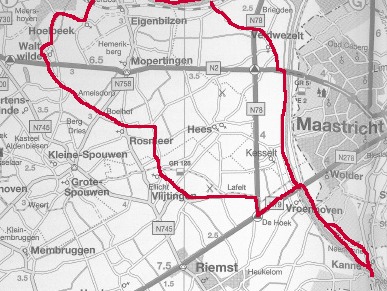
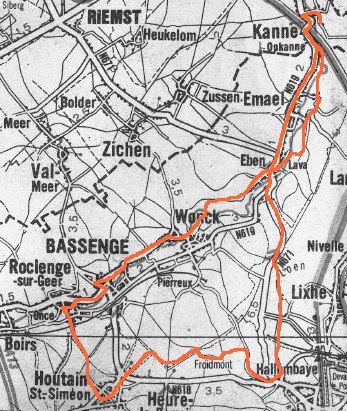
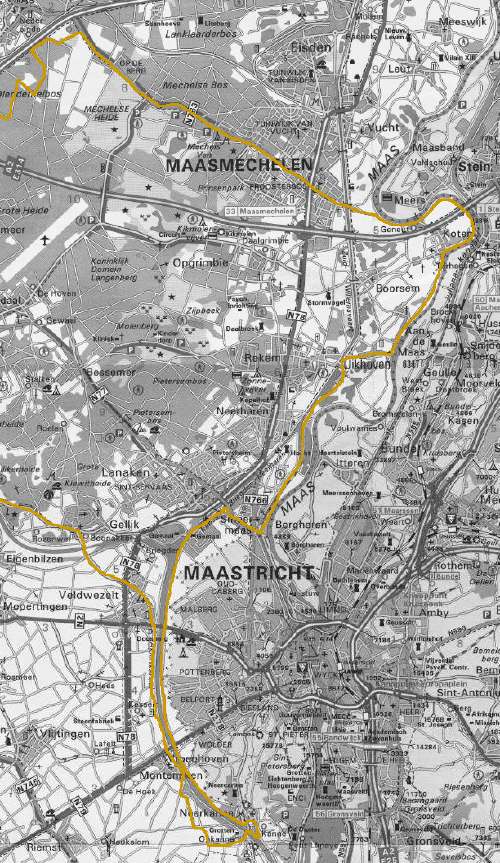
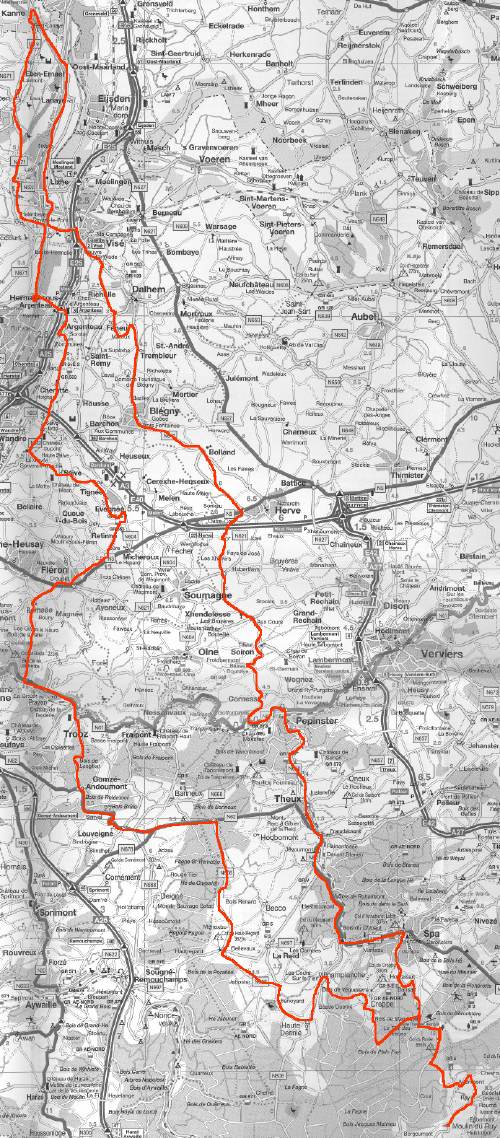
Herfst, harde zuidwestenwind, maar nog best lekker, 3/4 broek-weer. Bewolkt, twee sputters en twee keer een beetje zon. 16.45 – 18.45. Fijn rondje om te ontspannen van werk. Kanne – Eben – Halembaye – Froidmont – Heure L’ Romaine- Hermee – Aaz – Fexhe – Houtain St. Simeon – Roclenge – Bassenge – Wonck – Moulin du Broukay – Zichen/Zussen – (en even omhoog naar de Tour d’Eben) – Zusserdel – Kanne

Arrived: Only Revolutions, Mark Z Danielewski’s new book. Looks fancy.
Comes with a fancy website, that I do not want to look at since I like to judge a book by the book — the paper tome –, not by the peripherals. (When buying a new book I try not to read the text on the cover/jacket, try not to read the reviews).
http://www.onlyrevolutions.com
Yet here I wonder if the reader is assumed to have some (what?) information before reading the book. The book, as an object, has no end, it starts on both sides, two stories that I guess will intertwine in the middle. You have to turn and keep turning the book. All “O’s are printed in green or brown (bit gimmicky?). There are two columns of text and neither is narrative in the classical sense (as House of Leaves was) — judging by the first 25 pages (Sam side). The text seems closer to poetry, even brings to mind FW — the (re)circulation-theme and well, whoever spells ‘alone’ als ‘allone’ as Danielewski does here, brings FW to mind.
I do not know of a text that ressembles this. Either Danielewski is a writer who points to a future for literature (as Joyce did), — and is ‘beyond’ Eggers, Safran Foer, even DFW — or it’s one big mistake.
Just finished reading Ballard’s Kingdom Come. So now it’s time to browse some interviews and reviews.
These are insightful:
http://books.guardian.co.uk/departments/generalfiction/story/0,,1867982,00.html (Ursula Le Guin’s trashing of the book).
http://www.ballardian.com/ (Look for the interview “Rattling Other People’s Cage’s”.)
http://www.shaviro.com/Blog/?p=516. (Shaviro pretty much sums up the good points of the novel & I agree).
Though this might not be Ballard’s best novel ever, it is an interesting head-on attack of England’s suburban consumerism, and it’s tendency to racism. While reading I was reminded often of the scary Fortuyn-craze — sort of an attempt at political ‘revolution’ by the white suburban consumerist masses — in the Netherlands and it seems as if Ballard took a cue from that (though I don’t think he did really).
Of course there are the small “sociological essays”, a few lines with a theory of modern society. Vintage Ballard. The bits that make reading a Ballard-novel worthwile.
The plot is not as gripping as that in Cocaine Nights or Super-Cannes. And if I were a “normal reader” (but what is a “normal reader”? someone who reads a few pages to be entertained before going to bed, who reads for the plot?) I’d complain that the story is often a mess, especially toward the end, the plot is quite unbelievable and the characters are too flat. But hey, doesnt that come with a SF-view on modern society — a SF view that brings tendencies into focus by enlarging them, by extrapolating?
In any case, Ballard’s picture of England’s suburbia alongside the highway, the M25, is unforgettable.
Exciting news (well, for me): I’m on the program of the McLuhan-conference that takes place next year in Bayreuth, 14-18 February. I will be speaking about Esther Polak’s work, about GPS as a medium for art. The ‘line-up’ is awesome: De Kerckhove, Kittler, Pias, Zielinski, Broeckmann, Sloterdijk, Bolter, et cetera… Will be, well, very exciting to say the least.
http://www.americanstudies.uni-bayreuth.de/ls/conference_more.php?nr=1&program=1
Before getting to work (it’ll be mainly translating for the Stedelijk, the next few days) I click through a few music blogs and find this clip of Keiji Haino & Machizo Machida:
http://www.youtube.com/watch?v=GXrPFO6uvDA
More good stuff of Kaoru Abe, the legendary Japanese freejazz saxophonist:
http://www.youtube.com/watch?v=E6gyIHldJyg
http://www.youtube.com/watch?v=IqvwBos9HQk
http://en.wikipedia.org/wiki/How_to_Read_a_Book, about the book (with this title) by Mortimer Adler.
“The idea of communication directly from those who first discovered an idea as the best way of gaining understanding is the basis for Adler’s argument in favor of the reading of the Great Books. He claims that any book that does not represent original communication is an inferior source to the original, and, further, that any teacher, save those who discovered the thing which they are teaching, is inferior to these books as a source of understanding.”
Well, one has to be very conservative-minded to truly believe this. (Yet, in reading philosophy I do prefer to go back to the source.) It is hard to combine with ‘reading & writing on the web’ — though the web makes checking sources easier. But that’s slightly different.
Btw 1: Adler distinguishes 3 types (stages) of reading a book: structural, interpretative, critical.
Btw 2: More stuff from the business/communication perspective — definitely not my world –. A look at the book titles sez all… Annotation to books by Matt Vance on Minezone: http://www.minezone.org/wiki/MVance/BookNotes.
I’m beginning to wonder why I’m looking at these things…. I’m just going through a lot of tabs that I opened while browsing & reading about blogging, tagging, reading & knowledge…
Found this great post: http://ideamatt.blogspot.com/2006/02/how-to-read-lot-of-books-in-short-time.html. Title says it all.
It’s a summary of various methods from knowledge management, tips & tricks regarding how to process information quickly (well, how to parse it through the brain and only act on the important bits).
It sure isn’t novel-reading, it assumes text is just applicable information. One could ask the question if these methods, gathered by Matt Cornell, should properly be called ‘reading’ at all.
I use texts like this:
1. look at index, glossary, contents
2. quick look at a few passages, read conclusion
3. go read the book or part of the book, [or put away]; tag sentences with post-its
4. type (or copy-paste) (selection of) tagged sentences in blogpost, voodoopad or texteditor, for future use.
Does it work? I don’t know. What really counts is what I remember. And that process isn’t so one-dimensional. But I am happy with post-it-tagged books, and I can find quotes quicker now, and sometimes I remember texts better than I used to.
Btw: the methods mentioned by Matt Cornell also explain why I find it impossible to ‘properly’ read business books: too many superfluous sentences, too many skippable examples, everything get repeated. Those books are written for speed-reading.
Back in 1986 Michael Heim wrote in his book Electric Language: “A month in hyper-space can scatter the brain. Traditional books offer readers respite from hyperactivity. The book’s definitive, closed, linear argument lets mind and sensibility enjoy moments of inner harmony. Linear text offers the kind of contemplative thinking that goes beneath the surface” (xvi). Read “web” or ‘internet” or “blogosphere” for “hyperspace”. I’d say this is still true. But how much of this respite/contemplation do we need it to keep the world (and culture) running?
(Copy-pasted the quote from Dennis Jerz’s http://jerz.setonhill.edu/resources/blogtalk/index.html).
Sometimes I think advertising & marketing is so far in front of ‘us’ that we’ll never be able to catch up on what ‘they’ are doing. But a recent marketing-conference in Maastricht, http://www.marktpleindm.nl/, suggests that ‘they’ are not ahead. (Came across it through one weblog, http://ross.typepad.com/, referring to a social networking workshop for the CIA, led by a.o. David Weinberger, and checking Weinberger’s blog, http://www.hyperorg.com/blogger/index.html, and finding out he’s in Maastricht at the moment). The whole conference is centered around the Cluetrain Manifesto, of 1999. Yes, that’s 7 years ago. ?!? So while the CIA is hiring ‘the big shots’ for a workshop to learn better how to use social networking tools and wiki’s, the marketeers are only now getting onto the idea that ‘markets are conversations’? Hmmm. I don’t believe it. Well, it’s a bussiness networking conference. That explains.
What strikes me more is that it takes me three clicks to go from literary theory to blogging theory, to software development, to the CIA, to marketing and back again.