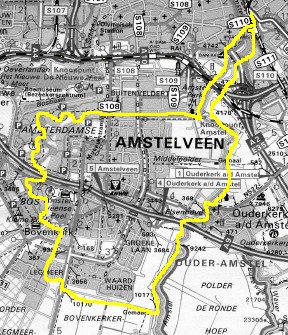
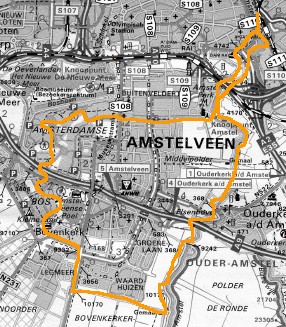
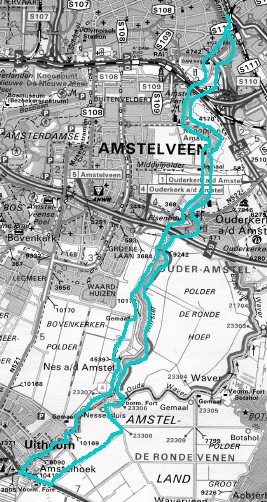
134 / 1018 / 5.00

12.00 – 17.00. Ik reed en werd niet moe, alsof ik nog uren had kunnen doorgaan. Prachtig herfstweer, zon, nauwelijks wind, en alleen aan het einde even lichte regen. Maar 1 weg de stad uit (marathon). Door t bos rijden: het was er wel erg druk en bij kasteel Groeneveld had ik het gehad met uitwijken voor wandelaars op het fietspad en reed pardoes helemaal de verkeerde kant op.

Marcusstraat – Gooiseweg – Diemen – Kraaijenhof – Gaasp – Driemond – Weesp – Vecht – Googpad – Graveland – Spanderswoud – Corversbos – Hilversums kanaal – Kerkelanden – Zwarte Berg – Laarser Bos – Maartensdijkse Bossen – ri. Soest – Pijnenburg – Bosbad – Groeneveld – Baarn – Eemnes – Huizen – Blaricum – Valkeveen – Naarden Vesting – Naardermeer – Vecht – Weesp – Gaasp – Gooiseweg – Marcusstraat

2009_10_18

cycling,nl | October 20, 2009 | 21:06 | Comments Off on 134 / 1018 / 5.00 |

133 / 1017 / 2.20

Vreemd rondje: ik zou met een goed uur weer thuis zijn, om te gaan wandelen, maar F. belde me toen ik bij Weesp was dat ze zich had vergist in de tijd, en ik wel iets langer kon rijden als ik wilde. Flinke noordenwind en volop zon na een paar buien.

Marcusstraat – Diemerpark – Muiden – Vecht – ri. Naardermeer – Vecht – Weesp – kanaal – Gein – Abcoude – Ronde Hoep West – Ouderkerk – Amstel – Marcusstraat

2009_10_17

cycling,nl | October 17, 2009 | 14:36 | Comments Off on 133 / 1017 / 2.20 |

Raymond Federman (1928 – 2009)

Last week Raymond Federman died. I should write an obituary here, but I do not know where to start.

Federman has been very important to me, though I only met him once, in October 1992 when he was in Berlin for the theatrical production of The Voice in the Closet / La voix dans le cabinet de débarras and I took the train there, not having arranged anything. I was 25, I had graduated in Literary Theory at the University of Amsterdam with a thesis on, yes, Raymond Federman’s The Voice in the Closet and postmodernist theory (mostly theory of postmodernist American literature: Brian McHale, Ihab Hassan, Jonathan Culler, and Lyotard too).

This is 17 years ago. I cannot understand this is so long ago. I cannot understand that this was in a time when I did not have e-mail, before WWW, before gopher even. I was reading books, typed on my just acquired 2nd-hand Mac SE and wrote long letters to a friend living in Japan. I did not have a racing bike.

It was Eric Vos who had put the text by Federman on the reading list for a seminar on postmodernist fiction in 1989. It was taken from an anthology, and I had become quite interested in this text, 20 pages of perfectly justified blocks of text (actually each line containing if I remember correctly 68 spaces – using a monospaced letter the text would still be perfectly justified). No punctuation, a voice that seemed to go on and on at full speed, with references to jazz and to Beckett. I read it, tried to crack it, understand it. I wrote a paper on it, the paper led to a thesis, and the thesis eventually led to a proposal for a PhD. (I did get the job as a PhD-student, yet never finished the PhD-thesis: the WWW happened).

I was in my early twenties and had basically never done anything else than reading literature and studying. I loved it. I had started to make translations, just for myself, and had also tried my hand at translating The Voice in the Closet – I was that fascinated. I was working at Perdu (a bookshop/small publisher, organizing literary events, run by volunteers), and at some point the publishers there (I think it was Jan Oegema) must’ve asked me to finish that translation, as they were interested to publish it. I did.

Until that moment I’d never tried to get into contact with Federman himself. Literature being for me predominantly a world of books, the thought of writing to him to discuss translation issues hadn’t simply come up in my mind. Hey, I was just starting out! I did know some other people at Perdu who were trying their hand at translation, but they were translating dead writers, no use to try and consult them… So I tried to find out where to contact Federman (this was before the internet, remember), and got a fax-number. We send a fax from Perdu, asking for permission to publish a translation. Somewhere deep into the night a fax started to rattle in the USA and a 61 year old writer was astonished to learn that a small publisher in Amsterdam was willing to publish a Dutch translation of his 1979 book made by a young translator.

He must’ve told me that he was in Berlin that autumn, so I travelled there by train. I even forgot to bring the translation which was anyhow finished. Checked into a youth hostel, found out that the telephone numbers I was given were not correct, and well, what could I do: went to the theatre where the play based on the Voice in the Closet was to be performed that night, to buy a ticket. And there I luckily ran into people who were with Federman: I was introduced to him. I think we had dinner together, and drinks after the play, he was a sweet man, and full of energy, full of energy at every moment. I was at ease, we talked about his books, and a lot about jazz, about listening to jazz while writing, about improvisation, the rhythm of jazz and how it punctuates the day, and about The Voice in the Closet and he specifically urged me to be free with the translation, to feel free to turn it into flowing Dutch. I do not know if I managed to do that (I’m afraid to look at the translation again, afraid to find many many errors), but the advice has stuck into my mind. For me this has been a very important piece of advice, coming from Federman.

(In the end I stayed with a small publisher in Berlin, in a house where also a free jazz bass-player was living whose name I now forget and who made a delicious potato-soup from almost nothing. One of the following nights I went to see Motoharu Yoshizawa (sp?) and Merzbow, one of the best concerts I’ve ever witnessed.)

But I should write about Federman.

In december 1992 my translation of The Voice in the Closet was published by Perdu, in a trilingual edition. It sold out really quickly as it was put on the reading list of a seminar at Literary Theory – of course the print run was small, I think it was 300. It was presented on an evening at Perdu, at which also Graa Boomsma – who had interviewed Federman a few years earlier (but that interview never made it into his book on contemporary American literature) – spoke. It was on that evening that he gave me the tip that I should read William T. Vollmann.

I did translate more afterwards, a few stories by Vollmann, Mark Leyner, and by Jacques Servin – published in mostly small literary magazines. But I never became a translator of literature. Yet I still enourmously enjoy the translating trade and occasionally I do translations jobs, mostly texts about contemporary art and new media art.

Apart from the occasional e-mail I was never again in contact with Federman, who, true to his character discovered the internet rather early as a place to write and make his voices speak. The last years he was very active on his blog and his myspace-page – hey, the guy was over 80! and still sounded as if he had all the energy of a young man to spent.

I should write about Federman as a writer. His books. His bilingual voice. The Fiction Collective. His laughing. The surficition, the critifiction, the poems, the joy of language, the playgiarism –

http://raymondfederman.blogspot.com/.

en,reading matter,writing | October 16, 2009 | 16:09 | Comments Off on Raymond Federman (1928 – 2009) |

Baltan Night at Almost Cinema

Last friday I was in Gent, at the Baltan Laboratories Night of the Almost Cinema festival at the Vooruit. (Oops, ugly sentence in – at – of – at, anyway). I was nervous, having to moderate a talk with Edwin van der Heide, Lucas van der Velden, Bas van Koolwijk, Gert-Jan Prins and Tez, previous to 3 performances. Of course it went fine (as others said), and afterwards I could enjoy the 3 performances, having done my job.

First act: the Synchronator played by its creators Gert-Jan Prins and Bas van Koolwijk. This night was actually a kind of ‘premiere’, as the product, a neat box that adds video sync pulses and color coding to an audio input, was for the first time available, and for sale. (The very first one was bought that night by Edwin van der Heide): http://www.synchronator.com. I have seen both playing with previous set-ups before, but I do not remember that I’d ever seen them as duo. Seeing them as a duo adds a lot to the performance, as it is not only a discovery, a dialogue and a struggle between performer and instrument, resulting in sound and images. It doubles it, no squares it, by the dialogue and struggle that goes on between Bas van Koolwijk and Gert-Jan Prins. The audience follows that – and also sees how Bas van Koolwijk is more prone to ‘hook’ onto visual developments, whereas Get-jan Prins more often concentrates on what he finds in the sounds. Top.

The immersive audiovisual composition PV686 of Tez I’d seen and heard in a previous form at Sonic Acts. Here the circumstances were much better, with the four speakers in a square, and our ears on the height of the speakers. In that way the auditory illusion of the binaural beats could be enjoyed to its max, and I was happy to be able to quietly sit through the whole piece, also discovering that I found the use of flicker rather mild. (Normally I’m quick to leave when there’s a heavy use of flicker, I can’t stand strobscopes for a long time, but in PV686, it’s just the screen with slowly changing colors that flickers.) It is a rather meditative piece. I did not find the sound loud, yet some in the audience found it loud. It seemed to me that they interpreted the binaural beats as being ‘loud sounds’.

Edwin van de Heide played his LSP in the large nineteenth-century ‘balzaal’. I’ve seen it at least twice before, but never in a circumstance where I could fully concentrate on his performance. I was enthralled and fascinated this time with how he sculpts spaces with the laser and the colors. It’s SF-like, sure, and it’s the 3D-illusion, it’s like travelling into outer space, seeing the dimensions open up – all of that. But it is subtle, it is not at any moment corny, not at any moment a ‘big laser show’ on a techno party, it’s compositionally precise using all of the previous aspects to create an audiovisual experience that is interesting in itself.

Just a shame that the audience was so small. (On the other hand, that presented for those present an opportunity to enjoy it all without any distraction.)

art,en,music,software | October 16, 2009 | 14:57 | Comments Off on Baltan Night at Almost Cinema |

DNK 2: Australian / Swiss noise

The second of hopefully a series of rambling reviews of DNK-events, in which I will not try hard to stick to rules of good journalism, so there might be run-on sentences and you might stumble upon completely unrelated or irrelevant observations. Not to mention the spelling mistakes. Served here FYI.

[Oh, all the things you promise yourself to do. You really need perseverance, a bit of time, some stubborness, and a bit of being blind and deaf to other obligations, to keep those promises. Even quickly writing a few lines takes me more time than I’m willing to admit.]

I missed the second monday-concert of the 2009/2010 DNK-season which featured a solo performance by Kouhei Matsunaga and a reprise of the Avelãs-octet. Alas I also missed the DNK Local Noise! Night at the OCCII, with no less than seven acts, a.o. Brian McKenna, Johann Kauth and of course Andre Avelãs. Luckily I did make it to the jam-packed Australian night with a high profile program of 4 acts. I’ll give you my impressions here, and some reflections.

It started off with some straight-in-your-face hyperactive structured noise made by Australian composer/pianist Anthony Pateras on analogue stuff, and long-bearded Robin Fox on digital stuff. Though it was mostly impossible to discern which sounds exactly were made by whom, there was an element of dialogue, or maybe struggle, that made the flow of shrieks and noises interesting to listen to, apart from the element of constant discovery.

As if this was not enough (in volume and intensity), the Swiss saxophonist Antoine Chessex, started with presenting a true wall of noise, a hurricane blowing at the audience, generated by a massive distortion and heavy amplification of breathing into his tenorsax and sampled loops of it. I’ve hear Chessex before at DNK, and at the previous concert he started playing acoustically, and made a very captivating use of space and the contrast between amplified and non-amplified sounds. His approach starts where Brötzmann (and others) ended, he gives a new meaning to the tenor as an enormous “fog horn” sounding in from the sea. Chessex takes the most extreme elements of the “Machine Gun-tenor-approach”, and works wth them in a compositional way. (Also working with the space of sound). Standing waves (?) almost made the whole room vibrate and he sometimes blew almost inaudible on top of that. Reminiscent of Merzbow at its best. He ended with suddenly turning off all amplification and effects, and playing acoustically in the curtains. Then end. Again very impressive.

(Coming to think of it, it came close to what the grindcore band God was doing. I’ve heard them at Paradiso early nineties, the complete audience left, apart about 10 people, and at some point M., a friend of mine, held his ear in front of Tim Hodginkson’s sax and could not hear the sax-sound, although Hodginkson was blowing at the top of his lungs. But with God it was as if it was a case of badly balanced sound, here it was clear that it all sounded as intended).

The third set was a solo by Robin Fox, using laser. For me it was the second laser-performance in 4 days, and though there is always an initial sense of wonder on seeing the 3D-illusion, this set disappointed a bit. Or I should say that seeing Robin Fox, made clear how subtle, and complex LSP of Edwin van der Heide is, how much larger his repertoire and idiom is. Fox ony used one laser beam and no color. His mapping of sound to laser was rather dull in comparasion to Edwin van der Heide. It would have been fine for ten or fifteen minutes max, but the longer he played, the more it became apparant that the translation to laser of his improvised noise also took away the interestingness of the sound. On the other hand: the audience seemed to love it. Oh, and of course the fire alarm went off during the performance.

The night ended with the duo that I was most curious to hear: Pateras on piano with Max Kohane on drums. PIVIXKI is an ultra high energy piano-drums duo, spitting out ADHD metal-licks and condensed freejazz motives. Naked City in its hardcore-phase, only possibly more intense. There’s not one second rest, and after ten minutes of playing both are sweating ‘like hell’. The only negative thing I could say about it was that it was programmed as the last act: I was already too tired to enjoy it fully, intensely.

DNK,en,music | October 16, 2009 | 14:22 | Comments Off on DNK 2: Australian / Swiss noise |

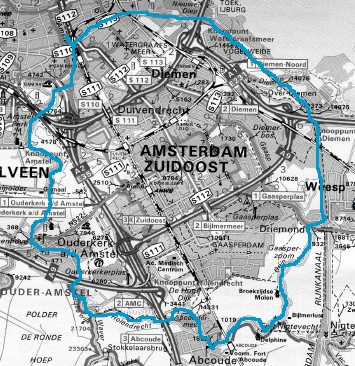
132 / 1015 / 1.20

Einde van de middag. Zonnig herfstweer en een koude noordenwind. Laagstaande zon op bomen met verkleurende bladeren. Raar rondje met stukjes Bijlmer, Gaasperplas en Gaasperzoom.

Marcusstraat – Weespertrekvaart – Diemen – Bijlmer – Gaasperpark – Gaasperzoom – Gein – Abcoude – Ouderkerk – Amstel – Marcusstraat
2009_10_15

cycling,nl | October 15, 2009 | 20:56 | Comments Off on 132 / 1015 / 1.20 |

131 / 1013 / 1.10

Kort ritje aan het einde van de middag, na werk. Zonnig herfstweer, aanmerkelijk kouder.

Marcusstraat – Ringdijk – Diemerpark – kanaal – Driemond – Gaasp – Penbos – Diemen – De Meer – Betondorp – snelweg – Marcusstraat

2009_10_13

cycling,nl | October 15, 2009 | 20:31 | Comments Off on 131 / 1013 / 1.10 |

130 / 1011 / 3.20

Zondagmiddag. Wat regen, dan wolken en veel zon en aan het einde weer een bui. Herfstweer. Flinke zuidwestenwind. Ik liet de windrichting de route bepalen. 14.50 – 18.20.

Marcusstraat – Amstel – Amsterdamse Bos – Takkade – Aalsmeer – Vuurlijn – De Kwakel – Blokland – Noordeinde – Zevenhoven – Noordse Dorp – Woerdense Verlaat – Geerkade – Portengense Zuwe – Boterwal – Oukoop – Loenersloot – Baambrugge – kanaal – Diemerpark – Ringdijk – Marcusstraat

2009_10_11

cycling,nl | October 11, 2009 | 21:24 | Comments Off on 130 / 1011 / 3.20 |

129 / 1008 / 1.47

Thuis schrijven en werken in de zon, dan aan het einde van de middag als de concentratie afneemt een ritje maken. Prachtig herfstweer, laagstaande zon = mooi licht. (47 km).

Marcusstraat – Amstel – Ouderkerk – Ronde Hoep West – Veldweg – Waverveen – Botshol – Ronde Hoep (klein stukje Winkel v.v.) – Ouderkerk – Amstel – Marcusstraat

2009_10_08

cycling,nl | October 8, 2009 | 20:25 | Comments Off on 129 / 1008 / 1.47 |

128 / 1006 / 2.20

Dinsdagmiddag, tot Deventer met de trein, vanaf daar met de fiets naar Almelo om mijn ouders te bezoeken. Bewolkt en mild, een regenzone die tergend langzaam in noordelijke richting trok, en mij pas bereikte toen ik in Almelo was. 15 graden. Ik vind dat fijn fietsweer. Herfst. Het eerste stuk van de route is geen aanrader (als je mooi wilt rijden dan liever over Schalkhaar en later wat in zuidelijke richting), maar over de Borkeld = mooi, en de Burgemeester Knottebeltlaan rondom Rijssen is een racebaan door het bos.

Deventer – Colmschate – Bathem – t Loo – Borkeld – Rijssenseberg – Ypelo – kanaal – Almelo

2009_10_06a

2009_10_06b

cycling,nl | October 8, 2009 | 14:06 | Comments Off on 128 / 1006 / 2.20 |
« Previous PageNext Page »
This work is licensed under a Creative Commons Attribution-NonCommercial-ShareAlike 2.5 License. | Arie Altena