Finally…

Finally I redirected https://ariealt.net to this page. You still landed on my old blog until an hour ago. I made a page for the archives from 2002 till early 2006 and also finally wrote an about-page.

I deciced for now to put my ‘affiliations’ only on the about-page.

Still to add: friends & blogs I read…

blogging,en | July 5, 2006 | 17:01 | Comments Off on Finally… |

Critiques of Zizek

Ah, there’s even a wikipedia-page which enumerates several critiques of Zizek:

http://en.wikipedia.org/wiki/Critiques_of_Slavoj_Žižek

en | July 5, 2006 | 14:21 | comments (1) |

Zizek, The Parallax View

Walk into the library, see Zizek’s The Parallax View amongst the ‘new aquisitions’, borrow the book after seeing one chapter deals with Henry James’ late novels. After cycling sit in the garden and read through the book, starting with the introductions and using the endnotes and the index. In the morning read the chapter on Henry James. Conclusion: this is not a book for me — I won’t read all of it. Yet it has some good bits and good, controversial observations.

If I would analyze in detail why I do not like Zizek, I’d need a week. I do not want to spend that time on Zizek. Yet because “everybody” loves Zizek, and because he’s so widely discussed I feel compelled to give my two cents.

Warning: these observations are made after a very very shallow reading of the book.

Already in the introduction it goes “wrong” — for me –. Zizek takes up short-circuiting as (good) critical practice, and Lacan als priviliged instrument. No, sorry, I don’t agree. Read on.

Then he gives two anecdotes that supposedly should illustrate the radical separation of the fields of abstract art and prisons, Benjamin and Stalin. Again I don’t agree with this view (Zizek nevertheless does as if this seperation is received knowledge). Following that he theorizes that there is a ‘parallax gap’, and sees this as a first step towards a rehabilitation of dialectical materialism. Well, it begins to be very difficult now, for me, to agree on anything he’s going to write when I disagree so much with his starting points… Then it’s off to Hegel against Kant.

A nasty remark would be that his recourse to the parallax view shows he’s not ready for radical multiperspectivism not for a view that focusses on mediation and translation instead of on objects perceived by subjects. (Hmm, with my shallow knowledge of Kant-Hegel-Heidegger-philosophy I certainly would not be able to hold up this point against Zizek).

Still, I do not give up. And in the same pages I am struck by some good, and controversial opnions. For instance when he states that it’s easy to fall in love with a multitude of freethinkers who blossomed in prerevolutionary France, or the October Revolution, but that it’s much more difficult to recognize the horrors of the forced collectivization, the attempt to translate the revolutionary fervor into a new positive social order (see p. 5). Stressing then, that Stalinism as philosphically speaking “imbicility incarnate” is exactly the point.

Now, that is interesting.

But then it’s back to Hegel, Hegel, Hegel and off to Lacan and I loose the plot. When it becomes an illustration of Hegel being right after all, and the topicality of Hegelianism, I’m simply not interested anymore.

I read on, (and I read all the endnotes). I come across beautiful quotes from Marx (p. 54). I come across an interesting analysis of why Stalinism was better than Nazism.

Then there is a whole chapter in which Zizek, as a Lacanian tries to criticize the cognitive psychology of the Churchlands, Dennett and Damasio. But well, whereas I am interested in a criticism of cognitive psychology, I’m not interested in Zizek’s criticism.

In the last chapter he goes more deeply into current political philosophy, criticizing Badiou, Ranciere, Hardt/Negri and Agamben, putting forward — again — Bartleby as the figure of political revolt, but giving it an interesting twist that makes Hardt/Negri’s ‘philosophy’ look superficial.

Yes, Zizek does (sometimes?) play the role of the ‘fool’, putting forward controversial opinions, that can force a breakthrough, or alter the perspective. That is good. (But why then should I wade through all the Hegelian dialectics?)

Yes, Zizek is incredibly good when it comes to using movies (stories and scenes) to illustrate his point. Also in this book. He has a sharp eye and a lucky hand in choosing his examples.

More generally, what I find disturbing is that the book seems to be extremely badly structured. Zizek just moves from one thing to another, and often I fail to see where it connects. (Worst example, a page on the Kalevala where it’s totally unclear why that passage is there in the article). Also it’s badly written — rethorical questions abound. It is full of sentences like “Is not this … exactly the Lacanian…”. (Uhmm, well, no). Okay, international english is our lingua franca…

So, I have the feeling that 1. Zizek’s always haunted by Hegelian concepts — he cannot think in any other way (even if he tries to), (but he also does not want to think in any other way). 2. Zizek truely believes Lacanianism (through Hegel) furnishes us with the best analysis of reality.

Well. But then I thought: whereas Badiou can be really scary — if you start to think through his political philosophy, Zizek in the end is mainly funny. I guess that’s a good thing?

en,reading matter | July 5, 2006 | 14:06 | Comments Off on Zizek, The Parallax View |

62 / 2.40

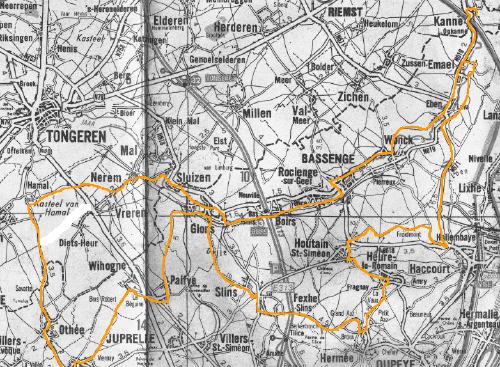
Veel te warm om (ver) te fietsen, zeker in de middag. Maar ja, de Tour komt langs en ik heb al te vaak gelegenheden verzuimd om de koers te zien. Ik stap dus op de fiets voor een ritje Veursbos v.v. — daar wil ik de Tour voorbij zien komen (het bos biedt schaduw; in Valkenburg is het toch kermis; en verder is het eigenlijk toch nogal saai, zo’n tourdoorkomst). Kanne – Lanaye – Moelingen – Gravensvoeren – St. Martensvoeren – Veurs – Veursbos – Veurs – St. Pietersvoeren – Rullen – St. Jean de Sart – Val Dieu – Mortroux – Dalhem – Bombaye – Berneau – Moelingen – Lixhe – kanaal – Kanne

cycling,nl | July 5, 2006 | 13:15 | Comments Off on 62 / 2.40 |

Cosplayers

“I am my character”. Salon @ Mediamatic, monday July 10th: http://www.mediamatic.net/artefact-11828-en.html.

And the last Metropolis M is all about Fake Identities: http://www.metropolism.org/.

en,free publicity | July 5, 2006 | 12:45 | Comments Off on Cosplayers |

RSS

Last week I made another attempt at structuring my information-gathering behavior. I’m not sure if it is necessary, but I feel it is necessary. Generally I am relying solely on my own memory, being helped a bit by my browser who supplies a full url when I start typing www.cy… or n…. or blo… I visit a few blogs, maybe am reminded of a few places by glancing at the links-lists. But that’s it. I think I’m missing too much and forgetting too many good places. For instance, I always feel helpless when I’m trying to remember where to go for political news, or political commentary.

What I am searching for is something that would come close to one’s daily, personalized newspaper + weekly magazine. Information on topics (and from commentators and reporters) that you’d like to keep in close touch with. You pick up on it during breakfast, and it might keep you occupied later on in the day when you feel like catching up some more.

(And no my dear newspaper-journalists, todays newspapers do not have that function anymore. Not for me. However much I like newspapers — and last week I enjoyed reading De Volkskrant and the NRC in the park. It happens too often that a whole newspaper only contains one or two articles that I want to read (and pay for). That is including the news and including the cultural reviews and the sportspage. And looking at the development of newspapers I am very pessimistic. Yes, there have been good innovations: the routing has become much better, as well as the lay-out. But the content is diminishing, and I don’t generally identify a lot with all the lifestyle-stuff. The choice of what belongs on the front page is mediocre (NRC) to ridiculous (De Volkskrant) — and then we’re talking quality newspapers. Okay, I can live with that, but then, there are not many commentators or ‘columnists’ that I like reading. (The attention given to the Jan Blokker affair — almost 80 years old he leaves the Volkskrant for the NRC — is equally ridiculous. Yes, it shows very well how newspapers are managed, but hell, please give someone else a chance after 35 years. I cannot remember that I’ve ever been struck by a piece written by Jan Blokker. The same applies to Hofland. By which I mean to say: I do not want to go back to the “good old times” of newspapers. The problem with the ‘Blokker-affair’ is that the whole decline of the quality newspaper is seen in terms of the “good old newspaper” versus “the new newspaper of the evil manager”. That’s not a very helpful perspective when we try to find ways to ensure “quality information” and “quality journalism”.)

Sorry for ranting.

Getting back to topic. There are several ‘tools’ (? or rather techniques, or strategies?) to accomodate this situation (the problem of daily information-gathering). These are some of them:

— bookmarks. (They are usefull as ‘earmarks’ in a book. For me not useful for structuring daily information gathering).

— social bookmarking. (Great for discovering good stuff and getting an idea of the importance of certain sources. Not useful for structuring daily information gathering).

— put your own blog in the centre: your linklist is the list of blogs/sites to check daily. (I know I probably should do this. I tried in the past. I hardly used it then. Maybe it’s different when I would integrate del.ico.us and some Technorati-stuff. Maybe it’s different now I use WordPress. Yet I also know I’m stubborn).

— an old-fashioned personal links-page. (I made that. The lists became too long. I sometimes use it, when I get stuck or think I’ forgetting sources of information. Mostly I find out I actually did not forget anything.)

— use RSS and an RSS-reader.

Well, that’s the attempt of last week. I picked up on NetNewsWire again. Cleaned up the list of subcriptions (and rediscovered some forgotten sites) and then spent some time revisting blogs, searching and subscribing to feeds. In fact RSS sounds like exactly the solution for my ‘problem’. Well, it’s not the first time for me to think that. I tried it before. It worked when I was spending unconnected time in trains, I spent much of that time reading through feeds. I was back to personal memory and clicking links as soon as I was connected.

So I’m trying again, because I hope for a bit more structure, and more general and political information, now I’m reading less and less newspapers. Disappointment: blogs that are central for you that do not do RSS. Newssites that do not have feeds.

Live is not perfect.

blogging,en,research,ubiscribe | July 4, 2006 | 12:55 | Comments Off on RSS |

Private / public

More Danah Boyd on privacy (I’ve been catching up on reading RSS-feeds): http://www.zephoria.org/thoughts/archives/privacy/.

How much of our “private” information do we voluntarily reveal online? When’s the moment that we actually do not care anymore? At what point does the public – private difference not apply anymore to how we live, give form to and structure our lives? Do (young?) people make a difference between a public and a private self; or rather between different public selves?

Just wondering.

blogging,en,research,ubiscribe | July 4, 2006 | 11:57 | Comments Off on Private / public |

Erving Goffman, The Presentation of Self in Everyday Life

“For the purpose of this report, interaction (that is face-to-face interaction) may be roughly defined as the reciprocal influence on individuals upon one another’s actions when in one another’s immediate physical presence. (…) A ‘performance’ may be defined as all the activity of a given participant on a given occasion which serves to influence in any way any of the other participants. Taking a particular participant and his performance as a basic point of reference, we may refer to those who contribute the other performances as the audience, observers, or co-participants. The pre-established pattern of action which is unfolding during a performance and which may be presented or played through on other occasions may be called a ‘part’ or ‘routine’.” p. 26/27

(At which point Goffman refers to Von Neumann & Morgenstern’s The Theory of Games and Economic Behaviour in a footnote).

“A status, a position, a social place is not a material thing, to be possessed and then displayed; it is a pattern of appropiate conduct, coherent, embellished, and well articulated. Performed with ease or clumsiness, awareness or not, guile or good faith, it is none the less something that must be realized.” p. 81

(Reminder to myself: on p. 232/233 Goffman describes five perspectives for analyzing ‘social establishments’: technical, political, structural, cultural and dramaturgical).

“In this report the performed self was seen as some kind of image, usually creditable, which the individual on stage and in character effectively attempts to induce others to hold in regard to him. While this image is entertained concerning the individual, so that a self is imputed to him, this self itself does not derive from its possessor, but from the whole scene of his action, being generated by that attribute of local events which renders them interpretable by witnesses. A correctly staged and performed scene leads to audience to impute a self to a performed character, but this imputation — this self — is a product of a scene that comes off, and is not a cause of it. The self, then, as a performed character, is not an organic thing that has a specific location, whose fundamental fate is to be born, to mature, and to die; it is a dramatic effect arising diffusely from a scene that is presented, and the characteristic issue, the crucial concern, is whether it will be credited, or discredited”. p. 244/245

The next paragraph is even better maybe; Goffman regards the person as a “peg on which something of collaborative manufacture will be hung for a time”, while the means for producing selves are “often bolted down in social establishments”. The theater metaphor provides him with the idea of a ‘back region” with “tools for shaping the body”, a “front region with its fixed props”; co-participants on stage and an audience. He then states: “The self is a product of all of these arrangements, and in all of its parts bears the marks on this genesis.” p. 245.

(It’s this framework that allows for applying ‘Goffman’ to the scene of personal publishing.)

“A character staged in a theatre in not in some ways real, not does it have the same kind of real consequences as does the thoroughly contrived character performed by a confidence man; but the succesful staging of either of these types of false figures involves use of real techniques — the same techniques by which everyday persons sustain their real social situations.” p. 246/247

Erving Goffman, The Presentation of Self in Everyday Life, Penguin Books, London, 1990 (1959).

Goffmann applied to blogging by Danah Boyd: http://www.zephoria.org/alterity/archives/2005/03/goffman_and_pos.html.

en,quotations,research,ubiscribe | July 4, 2006 | 11:42 | Comments Off on Erving Goffman, The Presentation of Self in Everyday Life |

85,5 / 3.47

Te warm om te fietsen en te warm om te werken. Knalzon & 32 graden. In de ochtend per trein terug uit Amsterdam naar Maastricht & Kanne. Te warm om te fietsen? Er stond een lekker windje — toch fietsweer. 15.45 – 19.45. Met de laatste kilometers van de touretappe van morgen — dus ook de laatste kilometers van de tourtocht van vandaag. Rustig gereden — en dankzij de oostenwind was de tweede helft supermakkelijk. De Cauberg had ik dit jaar nog niet gereden — saaie helling, lastig als je sprint, niet moeilijk als je rustig rijdt. Kanne – Lanaye – Moelingen – St. Martensvoeren – Ulvend – De Planck – Veursbos – Teuven – Opsinnich – Sippenaeken – Terziet – Cameriger berg – Holset – Lemiers – Orsbach – Bocholtz – Baneheide – Eys – Trintelen – Etenaken – Valkenburg – Berg – Maastricht – Kanne

cycling,nl | July 4, 2006 | 10:50 | Comments Off on 85,5 / 3.47 |

Just reading

I spent the last few days in Amsterdam & I don’t seem to do much more here than reading, just reading, devouring pages of text, for pleasure.

Nicholson Baker, Checkpoint. Baker’s novel about a guy who plans to shoot George W. Bush. The American reviews trashed the book, but I quite liked it, as an intelligent exposition of the sort of Bush-hatred that besets so many people.

Samuel Butler, Erewhon (almost finished). A classic, mentioned often in the literature on science & technology because in the upside-down world of Erewhon machines are outlawed. Enjoyable satire.

Joseph Conrad, Typhoon. Read this one in the Dutch translation and decided to more often read novels in translation: more reading pleasure (that is, if the translation is a good one). I’ve read Conrad’s Nostromo twice in English and still don’t get what it is about, seems all too subtle for my knowlegde of the language. Typhoon is the sort of perfectly built and carefully told narrative, with a main character that you’ll never forget — a story that makes you want to turn back to pre-1920’s literature.

J.G. Ballard, Running Wild. Novella, about murders in a gated community outside London. Now comes across as a sketch or a study or his later novel Cocaine Nights and Super Cannes. (I now see that a new Ballard-novel is announced for september).

Alfred Jarry, Superman (partly). Also in Dutch translation. Funny, hilarious.

Joris van Casteren, In de schaduw van de Parnassus. About twenty interviews with Dutch poets that never made it. Interesting because it sketches how the literary systems works. In these interviews one sees what is thrown out, what is forgotten, these poets had their work published at some point, but then did not stand ‘the test’ of quality, of perseverance, of conforming just that little bit, of time (the fashion changed).

And lots of papers.

Also revisited bits and pieces of Ihab Hassan’s early writings on postmodernism, as they are assembled in The Postmodern Turn. (It amazes me again how fresh those essays are, after so many years, how fresh his way of playing with the essay-form). And scanned through some of Erving Goffman’s The Presentation of Self in Everyday’s Life that I picked up from the Jan van Eyck library.

en,reading matter | July 1, 2006 | 23:02 | Comments Off on Just reading |
« Previous PageNext Page »
This work is licensed under a Creative Commons Attribution-NonCommercial-ShareAlike 2.5 License. | Arie Altena