Comment problems fixed
If y’r not reading the comments, you might ‘ve missed that the comment-problems are fixed. (Thanks Peet!)
If y’r not reading the comments, you might ‘ve missed that the comment-problems are fixed. (Thanks Peet!)
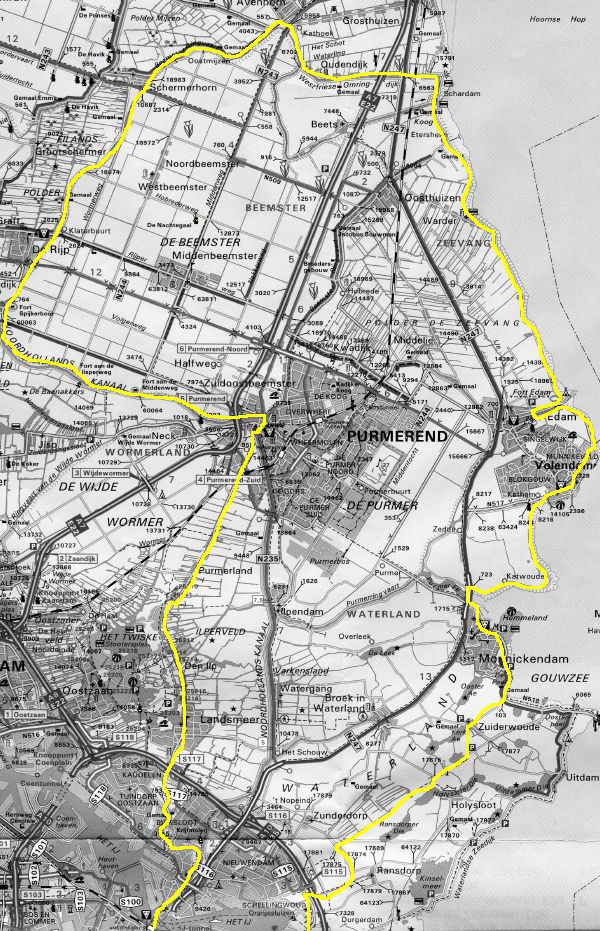
Zondag, de wind gedraaid naar het zuidwesten klimt de temperatuur tot voorbij de 20 graden. Opnieuw fantastisch fietsweer. 14.15 – 18.30. Zon. Rondje Zeevang en Beemster. Hmm, toch niet mijn favoriete terrein, al is de Beemster mooi, en zeker het stukje langs het Noord-Hollands kanaal van Spijkerboor naar Purmerend. Ik mis bos of duinen voor de afwisseling. En Volendam is een hel. Aan het begin denk ik via de Oranjesluizen te rijden, maar da’s geen goed idee, tenzij je lang wilt wachten. Al is het een prachtig punt. De fietsrouteknooppunten zijn toch een uitkomst in een gebied dat je wat slechter kent.
Marcusstraat – Ringdijk – Nesciobrug – Oranjesluizen – Schellingwouderbrug – Zuiderwoude – Monnickendam – Katwoude – Volendam – Edam – Schardam – Oudendijk – Kathoek / Averhorn – Schermerhorn – De Rijp – Spijkerboor – Purmerend – Purmerland – Landsmeer – Amsterdam Noord – pont – Marcusstraat
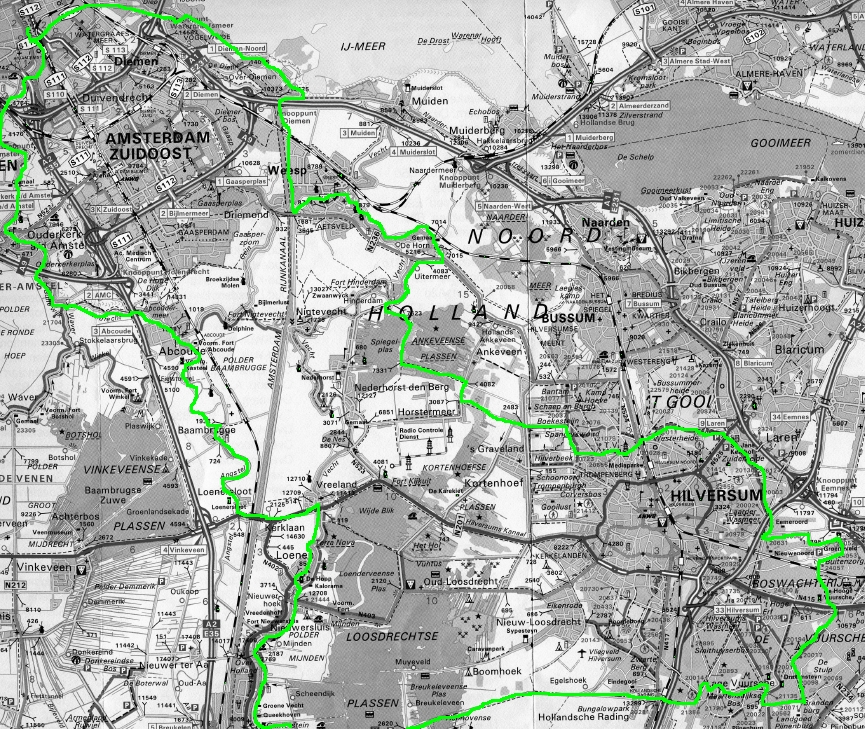
Zaterdagmiddag, 14.30 – 19.00. Tja, nog steeds van dat fantastische weer, felle zon, beetje frisse oostenwind, bloesems & bloeiende bloemen, 16 graden. Voor een groot deel het rondje Heuvelrug gevolgd, waardoor ik net een andere route over de onverharde fietspaadjes maakte – o.a. met een blokje kasteel Groeneveld.
Marcusstraat – Ringdijk – Nesciobrug – Diemerpark – elektriciteitscentrale – kanaal – Weesp – Googpad – ‘s Graveland – Spanderswoud – Crailose brug – St. Janskerkhof – kasteel Groeneveld – Bosbad – Pijnenburg – Lage Vuursche – Hollandsche Rading – Tienhoven – Breukelen – Loenen – Loenersloot – Baambrugge – Abcoude – Ouderkerk – Amstel – Marcusstraat
http://improvisingguitar.blogspot.com/ brings to my attention that he cannot leave comments here. I’ve tried it myself, not even I can leave comments… Apparently there’s something wrong. Must’ve happened since the blog was moved to another server. We’ll look into it.
… first of all the Genesis exhibition in the Centraal Museum in Utrecht – curated by Emilie Gomart: http://www.centraalmuseum.nl/page.ocl?pageid=133&expo_id=154&filter=3. About “information” in arts and science, with amongst others works by Driessens & Verstappen, Lilian Schwartz, John Whitney, Stan VanderBeek, Karl Sims, Frieder Nake and Saskia Olde Wolbers.
… then, coming up, bit international . [Nove] Tendencije – Computer and Visual Research, at the Neue Galerie in Graz, Austria, curated by Darko Fritz, with all and everything from the ground-breaking New Tendencies-exhibitions from the sixties, that was early to showcase computer art – including works by Manfred Mohr, Francois Morellet, Edward Zajec, Stan VanderBeek, and 89 other artists. No info on this exhibition online yet: http://www.neuegalerie.at
… and well, I should mention here the DEAF-exhibition too, in Rotterdam (Las Palmas): http://www.deaf07.nl, with amongst other Marnix de Nijs, Garnet Hertz and Zachary Lieberman. Beautiful works, but the presentation could be better. There are really too many sounds of different installations bleeding over into each other. For most works this is not really a problem, but it does take a lot away from the experience of Ondulation.
… oh, and of course Meta_Epics II of telcosystems at Tag in The Hague. Superb. http://www.telcosystems.net and http://www.tag004.nl/new/system/main.php?pageid=301.
Next year: experience design starts at the HKU, Utrecht: http://experiencedesign.hku.nl/index.php, looking at a world in which all things & everything will be connected.
I like to go to the public library to get a new stack of books. Every week, if I get the chance. Sometimes I leave the library thinking: “this is a good catch”. What exactly is a good catch? Books I really love or find necessary to read I will buy, so the library-good-catch represents a special category of books. Books I’d like to browse for a week, books I’d like to dip into for a bit to know what it’s about, books I will read for amusement, books on a subject I’m temporarily interested in but will not spend money on, books that are simply beautiful but too expensive, books I have to or want to consult.
Or, as an example, this list:
– a travel guide for Boston (I will go there later this year)
– a travel guide to Burgundy (little holiday in May)
– Chretien de Troyes, De Graal (new Dutch translation)
– Koen Vergeer, Yves T’Sjoen, Volksverheffing (poetry critism, poetry, theory)
– Quintus Ennius, Annalen (Dutch translation of the fragments of this early Latin epic poem)
– Willem Bilderdijk, Leven, ach! Wat zijt gij toch (anthology of this 19th century Dutch poet, of whom I’ve never really read anything)
– Louis Paul Boon, de kleine eva uit de kromme bijlstraat (Of course I have read that text, and have it myself, but when a new book from the Collected Works of Boon arrives in the library I can’t help myself, I have to lent it.)
and then, from the beautiful series of cycling books of De Eecloonaar:
– De Mannen achter Merckx
Sometimes by accident you read books that ‘fit together’. I had lent Tony Judt’s history of Europe after the war from the public library – I’ve been wanting to read a good history of twentienth century Europe for some time, and this seems to be the book to read now. I’ve dug into the first few chapters – they give a good impression of the chaos of Europe after the war, and Judt manages to give the reader a good insight in the situation as it was then, for the people who had to make the political decisions.
And then ‘the new Koen Peeters’ came out: Grote Europese Roman (Great European Novel), and being a ‘fan’ of Koen Peeters ever since I read Bezoek onze kelders en Conversaties met K. I immediately bought it, read it, finished it yesterday. I love Peeters tone, his really, really fine irony in how he writes on all the contemporary things from the world of marketing, without ever making it sound ridiculous. Although it is ridiculous, but also not, or as ridiculous as life is. (Can anybody please write an essay on Peeters’ tone – I’d love to read that…) It’s a lovestory too, it’s about giving, it’s about Europe as a myth – Peeters treats Europe here in the same way as he treated the subject of Belgium and of Brussels in his other novels. And of course there’s a character whose name is Marchand.
‘Het perenblog’ has copied the intro of the novel: http://perenblog.blogspot.com/2007/03/grote-europese-roman-1-opdracht-door.html.
He has some more “Peeters-stuff” online: http://perenblog.blogspot.com/2005/08/koen-peeters-en-ik-een-verzameling.html.
For those of you who don’t read Dutch, an early Peeters short story was translated and published in the Flanders-issue of the Review of Contemporary Fiction from, what, 13 years ago: http://www.centerforbookculture.org/review/94_2.html.
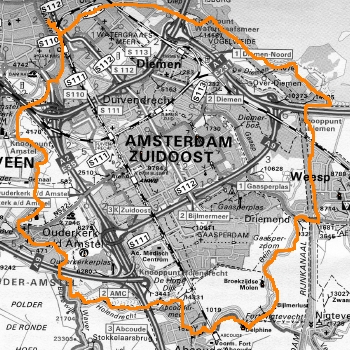
Vrijdag, 18.30 – 20.05. Voor het eten. Lastige wind uit het oosten, of ik heb geen macht in mijn benen. Nog steeds prachtig weer, helder, felle zon, zelfs in het begin van de avond. De seringen bloeien al, de kastanjes ook, al zijn de bladeren nog maar juist een paar dagen ontbot (hoe zeg je dat?), er is een boer die al heeft gemaaid, fluitekruid bloeit, zuring ook. Het heeft al sinds begin maart niet geregend.
Marcusstraat – Ringdijk – Nesciobrug – Diemerpark -elektriciteitscentrale – Weesp – Gein – Abcoude – Aboudermeer – Holendrecht – Ouderkerk – Amstel – Marcusstraat
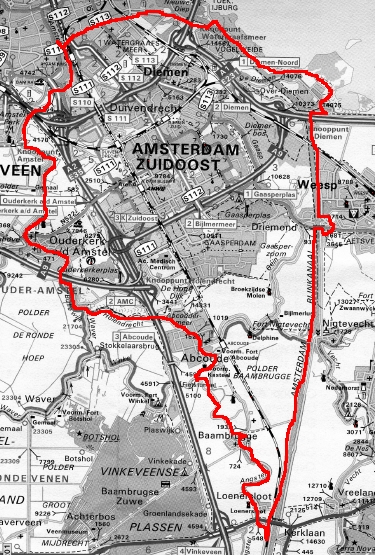
Woensdag, einde van de middag. Ideaal fietsweer, zon, lekker frisjes. Prachtig licht op het jonge groen en de bloesems. Flinke zuidenwind, en ik kan er almaar de vaart stevig inhouden. Eindelijk ‘ns een gemiddelde om te vermelden: 27.0. Weer een aantal stukjes die ik vrijwel nooit reed, zoals aan de oostkant van het kanaal tussen Muiden en Weesp.
Marcusstraat – Ringdijk – Nesciobrug – Diemerpark – elektriciteitscentrale – kanaal – Weesp – Driemond – Gein – Fort Nigtevegt – kanaal – Loenersloot – Baambrugge – Angstel – Abcoude – Ouderkerk – Marcusstraat